
Introduction
As cyber threats continue to evolve, organisations need more than just basic security tools — they need continuous monitoring, detection and response capabilities.
This is where a Security Operations Centre (SOC) plays a critical role.
So, what is a SOC, and how does it help protect businesses from cyber threats?
This guide explains what a SOC is, how it works, and why it’s essential for modern cyber security.
What is a SOC?
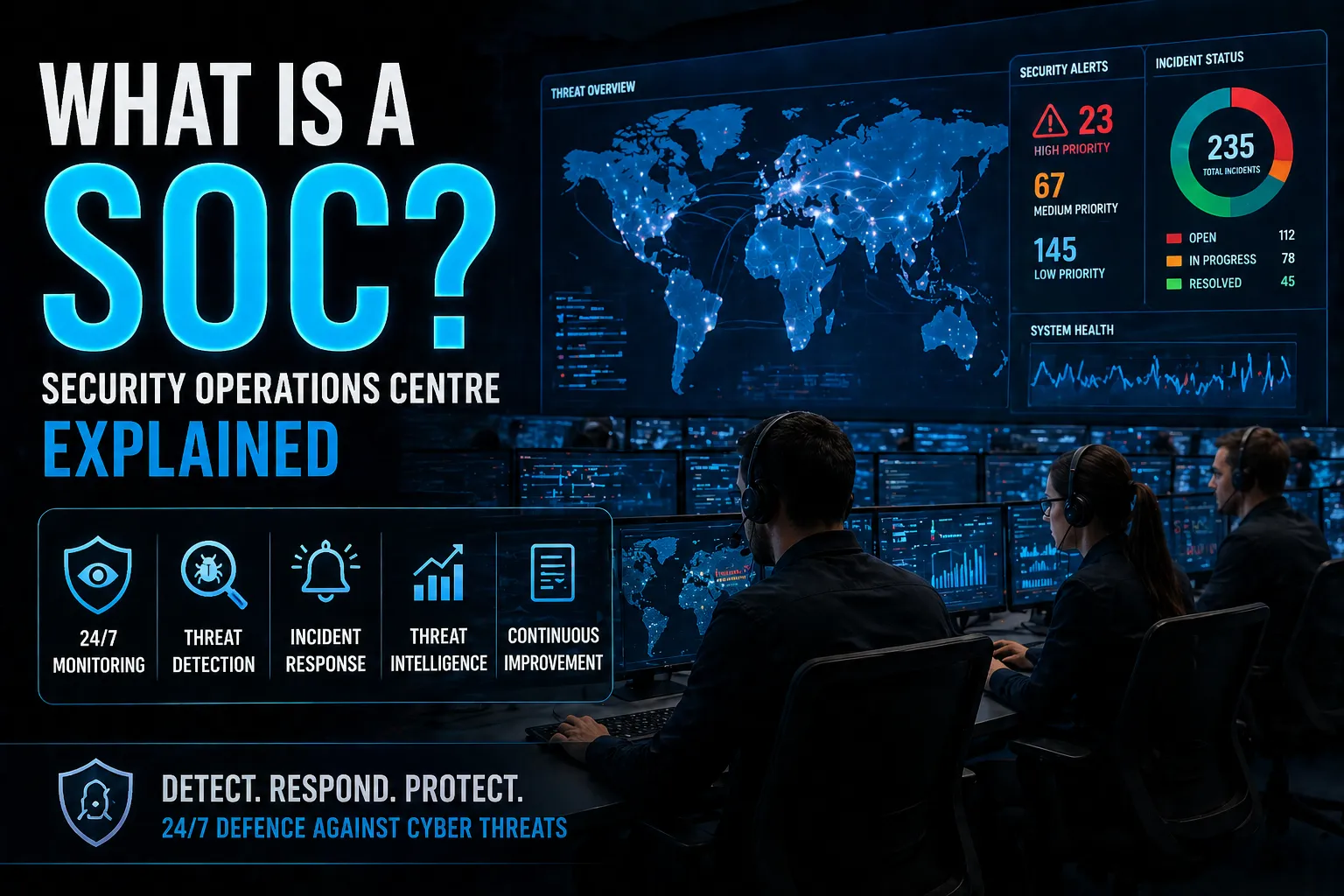
A Security Operations Centre (SOC) is a centralised function responsible for monitoring, detecting, analysing and responding to cyber security threats in real time.
A SOC combines people, processes and technology to provide continuous protection across an organisation’s systems and networks.
Core SOC functions include:
- Threat monitoring and detection
- Incident response and containment
- Log analysis and threat intelligence
- Security alert management
- Continuous security improvement
The goal of a SOC is to identify and respond to threats before they cause significant damage.
How a SOC Works
A SOC operates 24/7, monitoring systems and analysing data to detect suspicious activity.
Key components include:
- SIEM (Security Information and Event Management) – Collects and analyses logs
- Threat intelligence – Provides context on emerging threats
- Security analysts – Investigate and respond to alerts
- Automation tools – Improve response speed and efficiency
These components work together to detect and respond to threats in real time.
Key SOC Functions
1. Continuous Monitoring
The SOC monitors networks, systems and endpoints for suspicious activity.
2. Threat Detection
Security tools and analysts identify potential threats based on behaviour and indicators.
3. Incident Response
When a threat is detected, the SOC takes action to contain and mitigate it.
4. Threat Intelligence
The SOC uses intelligence feeds to stay ahead of emerging threats.
5. Reporting and Improvement
Incidents are analysed to improve future detection and response.
Why a SOC is Important
Cyber attacks can happen at any time, and many go undetected without proper monitoring.
Key benefits:
- 24/7 protection – Continuous monitoring of systems
- Faster detection – Identify threats early
- Rapid response – Contain incidents quickly
- Reduced risk – Minimise impact of attacks
- Improved visibility – Gain insight into security posture
Types of SOC Models
1. In-House SOC
Built and managed internally by an organisation.
2. Managed SOC
Outsourced to a specialised security provider.
3. Hybrid SOC
A combination of internal teams and external providers.
Common SOC Challenges
Operating a SOC can be complex and resource-intensive.
Challenges include:
- Alert fatigue from high volumes of data
- Shortage of skilled security professionals
- Tool integration complexity
- Maintaining 24/7 coverage
These challenges often lead organisations to adopt managed SOC services.
How a SOC Fits into Cyber Security Strategy
A SOC is a core component of a modern cyber security strategy.
It works alongside:
- Security Operations for continuous monitoring
- Incident response processes
- Threat detection and intelligence
- Network and endpoint security controls
Together, these capabilities help organisations detect, respond to and prevent cyber attacks.
Conclusion
So, what is a SOC?
It’s a centralised function that provides continuous monitoring, threat detection and incident response to protect organisations from cyber threats.
By implementing a SOC, businesses can:
- Detect threats earlier
- Respond faster to incidents
- Reduce cyber risk
- Improve overall security posture
FAQs
What is a SOC in cyber security?
A SOC is a centralised team responsible for monitoring and responding to security threats.
What does a SOC do?
It monitors systems, detects threats and responds to incidents in real time.
Do all businesses need a SOC?
Most organisations benefit from SOC capabilities, either in-house or managed.
What tools does a SOC use?
Common tools include SIEM platforms, threat intelligence feeds and monitoring systems.