
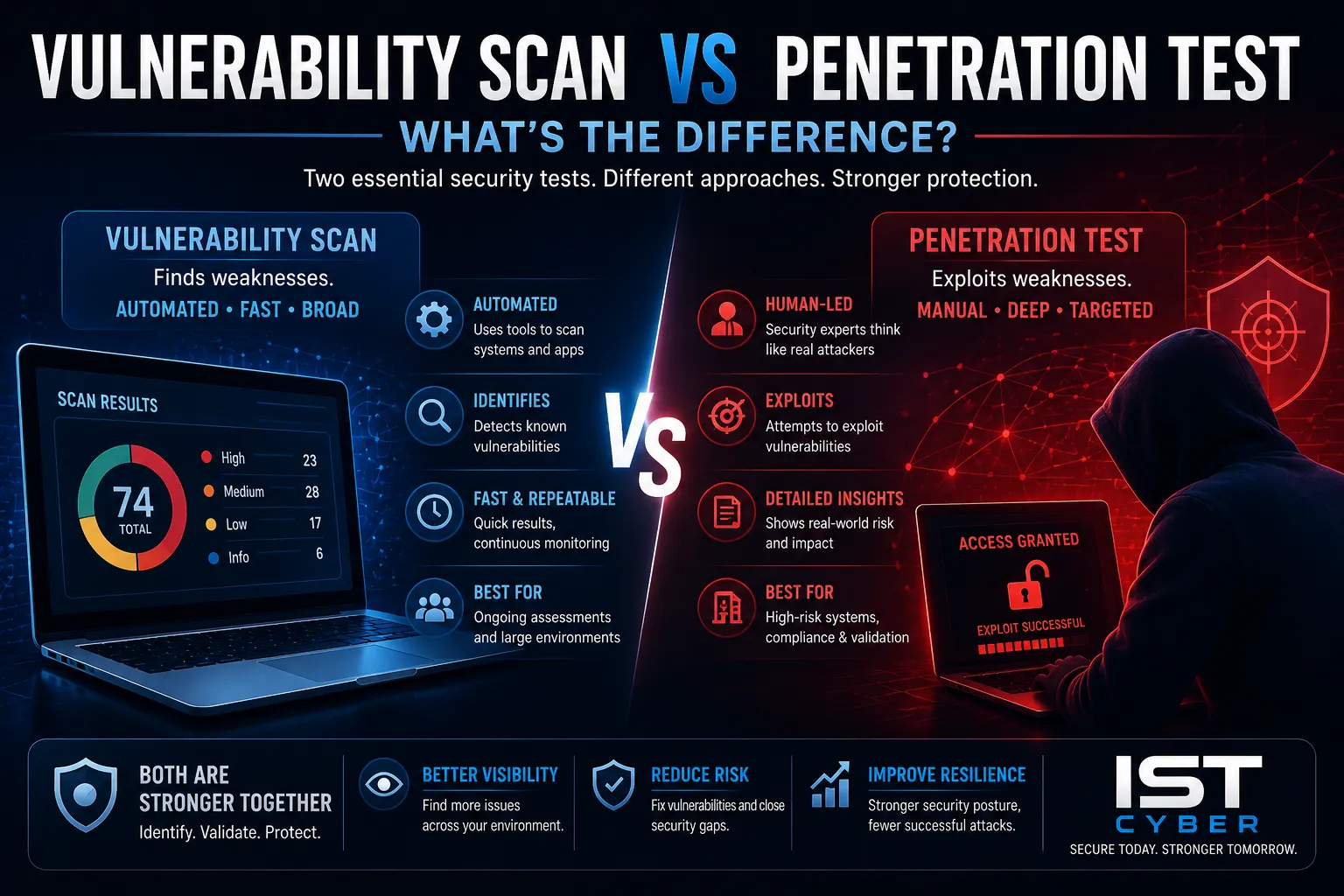
Many organisations use the terms vulnerability scanning and penetration testing interchangeably, but they are not the same thing.
While both are designed to identify security weaknesses, they differ significantly in depth, methodology and purpose.
So, what’s the difference between a vulnerability scan vs penetration test?
This guide explains how each works, their strengths and limitations, and when businesses should use them.
Vulnerability Scan and Penetration Test Explained
Vulnerability scanning and penetration testing are both security assessment methods used to identify cyber security weaknesses.
- Vulnerability Scan – An automated process that identifies known vulnerabilities
- Penetration Test – A simulated cyber attack performed by security professionals to exploit vulnerabilities
Both approaches are important, but they serve different purposes.
What is a Vulnerability Scan?
A vulnerability scan is an automated assessment that identifies known security weaknesses across systems, applications and networks.
Key features:
- Automated scanning tools
- Fast and repeatable
- Detects known vulnerabilities
- Provides prioritised findings
Best suited for:
- Routine security assessments
- Continuous monitoring
- Large environments
What is a Penetration Test?
A penetration test is a controlled, simulated cyber attack designed to identify and exploit vulnerabilities in real-world conditions.
Key features:
- Human-led testing
- Exploitation of vulnerabilities
- Realistic attack simulation
- Detailed remediation guidance
Best suited for:
- High-risk systems
- Compliance requirements
- Validating security controls
Key Features of Vulnerability Scans and Penetration Tests
| Feature | Vulnerability Scan | Penetration Test |
|---|---|---|
| Method | Automated | Human-led |
| Purpose | Identify vulnerabilities | Exploit vulnerabilities |
| Depth | Broad | Deep and targeted |
| Frequency | Regular / ongoing | Periodic |
| Time Required | Short | Longer engagement |
| False Positives | More common | Validated findings |
Why Businesses Need Both
Vulnerability scans and penetration tests complement each other.
Vulnerability scanning helps:
- Identify issues quickly
- Monitor environments continuously
- Reduce exposure to known threats
Penetration testing helps:
- Validate real-world risk
- Test detection and response
- Assess business impact
Together, they provide stronger visibility and security assurance.
Common Misconceptions
“A vulnerability scan is the same as a pen test”
False — scans identify vulnerabilities, while pen tests exploit them.
“Automated scans are enough”
Automated tools cannot fully replicate human attacker behaviour.
“Penetration testing replaces scanning”
Penetration testing should complement regular vulnerability management.
How This Fits into Cyber Security Strategy
Scanning and penetration testing are both key components of a broader cyber security strategy.
- Penetration Testing for real-world security validation
- Security Operations for continuous monitoring and detection
- Vulnerability management processes
- Threat detection and remediation
Combining these capabilities helps organisations identify and reduce cyber risk more effectively.
Conclusion
So, what’s the difference between a vulnerability scan vs penetration test?
Vulnerability scans identify known weaknesses automatically, while penetration tests simulate real attacks to validate risk.
By using both approaches, organisations can:
- Improve visibility into security risks
- Reduce attack exposure
- Strengthen detection and response
- Build a more resilient security posture
FAQs
What is the difference between a vulnerability scan and a penetration test?
A vulnerability scan identifies known weaknesses automatically, while a penetration test simulates real attacks to exploit vulnerabilities.
Are vulnerability scans enough for security?
No, vulnerability scans should be combined with penetration testing for deeper validation.
How often should vulnerability scans be performed?
Most organisations should perform scans regularly or continuously.
How often should penetration tests be conducted?
Penetration tests are typically conducted annually or after major changes.