
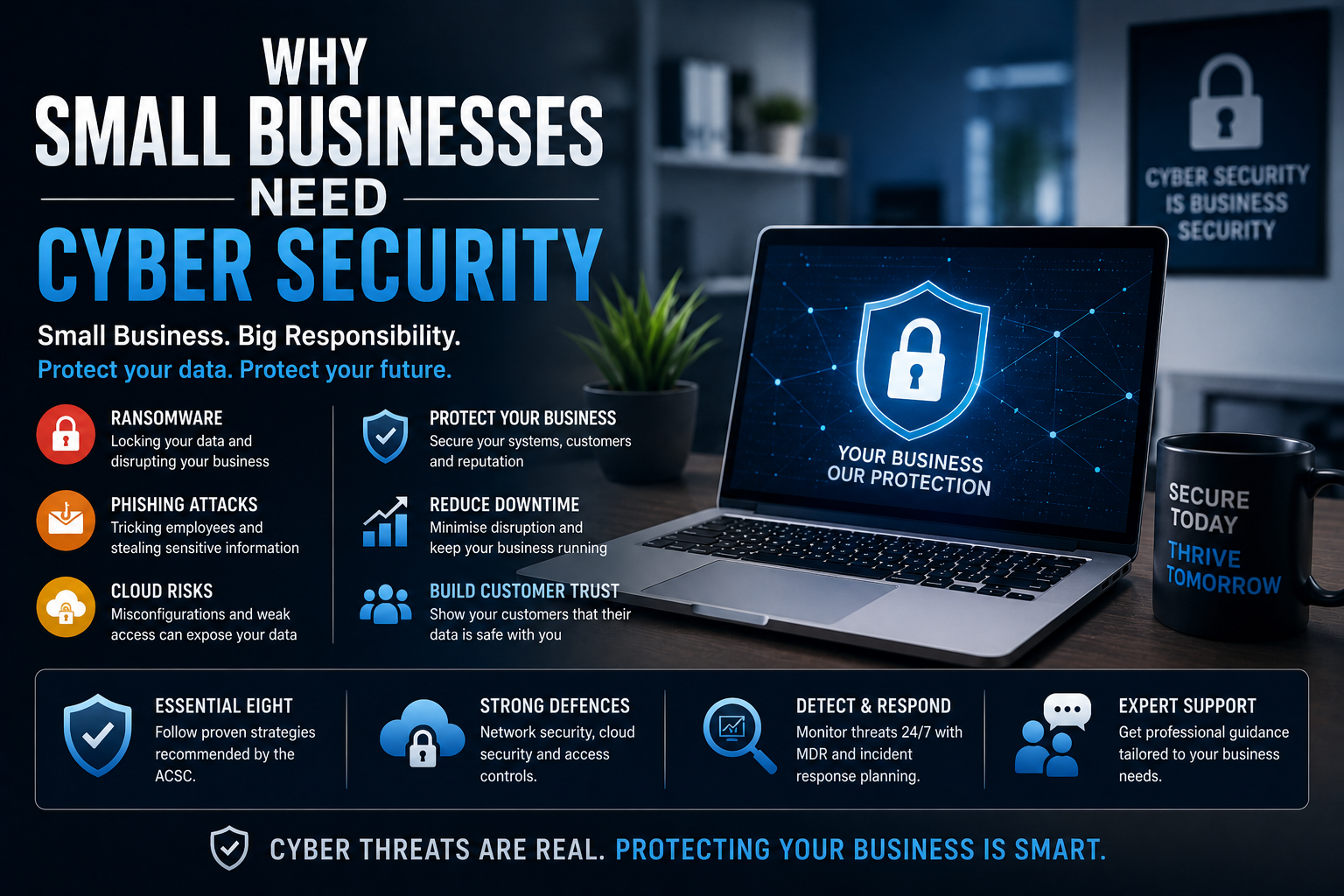
Many small business owners believe cyber criminals only target large organisations. Unfortunately, the opposite is often true. Small and medium-sized businesses (SMEs) are increasingly targeted because they frequently have fewer security controls, limited IT resources and valuable customer information.
From ransomware and phishing attacks to cloud breaches and stolen credentials, cyber threats can disrupt operations, damage customer trust and result in significant financial losses.
This guide explains why small businesses need cyber security, the risks they face and the practical steps every SME should take to protect its business.
Why Cyber Security Matters for Small Businesses
Small business cyber security is no longer optional. Every business that stores customer information, processes payments or relies on computers and cloud services is a potential target.
Modern cyber attacks are often automated, meaning attackers scan thousands of businesses looking for easy opportunities rather than targeting specific organisations.
Even a single successful attack can result in:
- Financial loss
- Business downtime
- Loss of customer trust
- Legal and compliance issues
- Reputational damage
Common Cyber Threats Facing SMEs
Ransomware
Ransomware encrypts business files and demands payment to restore access. Without secure backups and an incident response plan, recovery can be expensive and time-consuming.
Phishing Attacks
Phishing emails trick employees into revealing passwords, downloading malware or transferring funds to criminals. These attacks remain one of the most common causes of business breaches.
Weak Passwords and Stolen Credentials
Compromised passwords continue to be one of the easiest ways for attackers to gain access to business systems.
Cloud Security Risks
Cloud platforms such as Microsoft 365 and Google Workspace offer excellent security features, but incorrect configurations and weak access controls can expose sensitive information.
Unpatched Software
Outdated operating systems and applications often contain known vulnerabilities that attackers actively exploit.
What Data Are Small Businesses Protecting?
Even relatively small organisations hold information that is valuable to cyber criminals.
Examples include:
- Customer contact details
- Financial records
- Employee information
- Contracts and invoices
- Business emails
- Cloud-stored documents
- Intellectual property
Protecting this information is essential for maintaining customer confidence and meeting privacy obligations.
The Business Benefits of Good Cyber Security
Investing in cyber security provides benefits beyond simply preventing attacks.
- Reduce the risk of ransomware and phishing incidents
- Protect customer and employee information
- Minimise operational downtime
- Improve compliance with industry requirements
- Increase customer confidence
- Support long-term business growth
Strong cyber security also makes businesses more resilient to emerging threats.
Essential Cyber Security Measures for SMEs
Every small business should implement a combination of technical controls, staff awareness and ongoing monitoring.
- Enable multi-factor authentication (MFA).
- Keep operating systems and software updated.
- Perform regular data backups.
- Train staff to recognise phishing emails.
- Restrict user access using least privilege principles.
- Secure cloud services and remote access.
- Develop and test an incident response plan.
These measures significantly reduce the likelihood of a successful cyber attack.
The Essential Eight for Small Businesses
The Australian Cyber Security Centre’s Essential Eight provides practical strategies for improving cyber resilience.
These mitigation strategies include:
- Application control
- Patch applications
- Configure Microsoft Office macro settings
- User application hardening
- Restrict administrative privileges
- Patch operating systems
- Multi-factor authentication
- Regular backups
Implementing the Essential Eight can help reduce the risk of many common cyber attacks.
When Should a Small Business Seek Professional Help?
Many SMEs do not have dedicated cyber security staff. Working with experienced consultants can help businesses identify vulnerabilities and prioritise improvements before attackers do.
Professional cyber security consulting can include:
- Security assessments
- Penetration testing
- Cloud security reviews
- Risk assessments
- Security awareness training
- Managed Detection and Response (MDR)
For many organisations, proactive advice is significantly less expensive than recovering from a cyber attack.
How This Fits into Your Cyber Security Strategy
Small business cyber security should combine prevention, detection and response.
Businesses should consider implementing:
- Network Security to secure business infrastructure
- Cloud Security to protect cloud platforms and data
- Incident Response planning to minimise disruption during cyber incidents
- Cyber Security Consultation to identify risks and develop a tailored security strategy
Together, these services help businesses build a stronger security posture while reducing cyber risk.
Conclusion
Cyber attacks are no longer a problem reserved for large enterprises. Small businesses face the same threats but often have fewer resources to defend themselves.
By investing in practical cyber security measures, following frameworks such as the Essential Eight and seeking expert guidance where needed, SMEs can protect their data, maintain customer trust and continue operating with confidence in an increasingly connected world.
FAQs
Why do small businesses need cyber security?
Small businesses store valuable customer, financial and business information, making them attractive targets for cyber criminals despite their size.
What are the biggest cyber threats for SMEs?
Common threats include ransomware, phishing, stolen credentials, cloud security misconfigurations and unpatched software vulnerabilities.
What is the Essential Eight?
The Essential Eight is a cyber security framework developed by the Australian Cyber Security Centre to help organisations reduce the risk of common cyber attacks.
Can small businesses afford cyber security?
Yes. Many cyber security measures are affordable, and investing in prevention is typically far less expensive than recovering from a successful cyber attack.