
Australian organisations face increasing pressure to strengthen cyber security and meet compliance requirements. Two of the most commonly referenced frameworks are ISO 27001 and the Essential Eight.
While both aim to improve security, they serve different purposes and apply in different contexts.
So, what’s the difference between ISO 27001 vs Essential Eight, and which one does your business actually need?
This guide explains each framework, compares them, and helps you decide the right approach.
ISO 27001 vs Essential Eight Explained
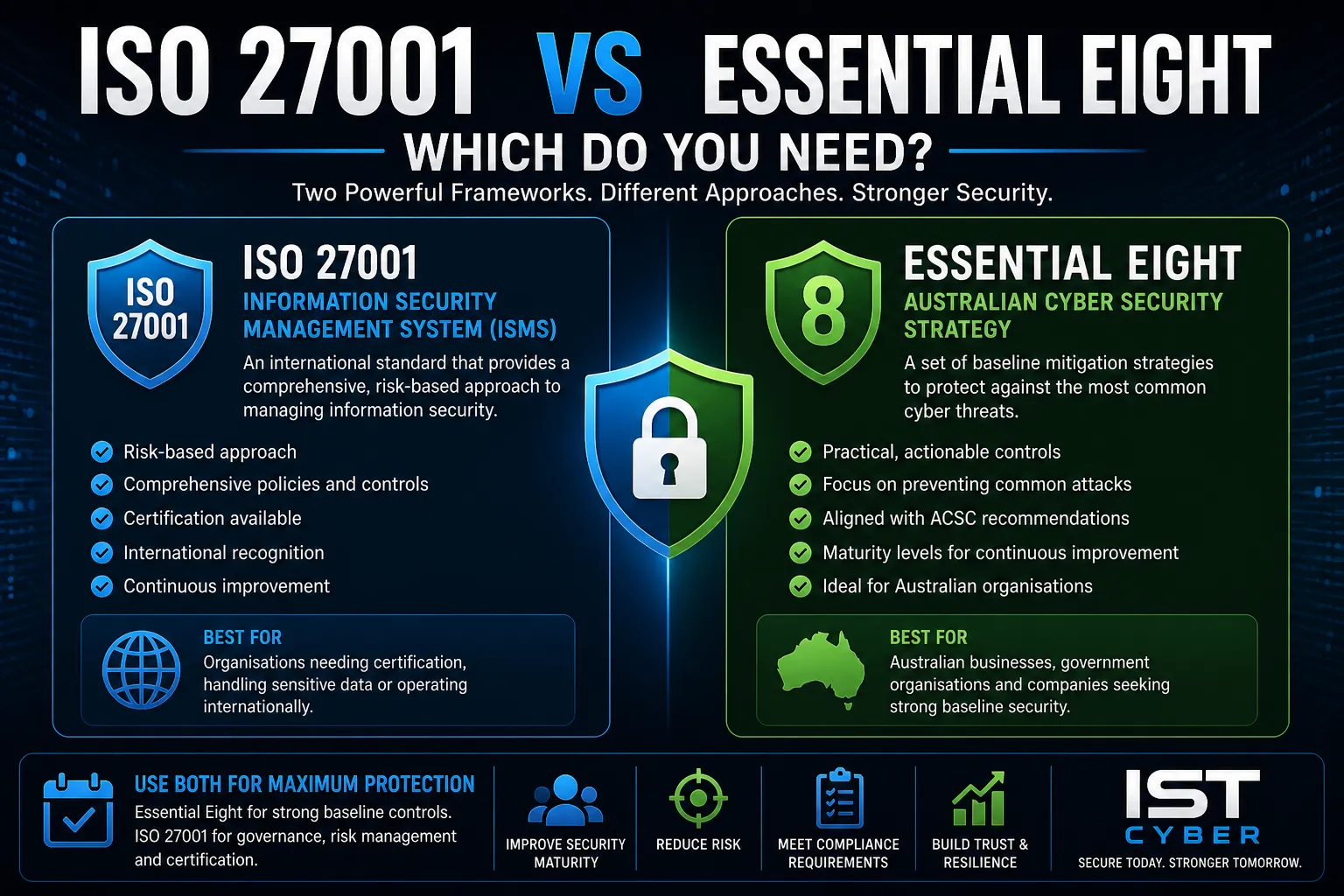
ISO 27001 and the Essential Eight are both cyber security frameworks, but they differ in scope, purpose and implementation.
- ISO 27001 – An international standard for information security management systems (ISMS)
- Essential Eight – An Australian cyber security framework developed by the ACSC to mitigate common threats
What is ISO 27001?
ISO 27001 is a globally recognised standard that provides a structured approach to managing information security risks.
Key features:
- Risk-based security framework
- Comprehensive policies and controls
- Certification available
- International recognition
Best suited for:
- Organisations handling sensitive data
- Businesses requiring certification
- Companies operating internationally
What is the Essential Eight?
The Essential Eight is a set of baseline mitigation strategies designed to protect organisations from common cyber attacks.
The eight controls include:
- Application control
- Patch applications
- Configure Microsoft Office macro settings
- User application hardening
- Restrict administrative privileges
- Patch operating systems
- Multi-factor authentication
- Regular backups
Best suited for:
- Australian organisations
- Government and regulated industries
- Businesses seeking practical security controls
ISO 27001 vs Essential Eight: Key Differences
| Feature | ISO 27001 | Essential Eight |
|---|---|---|
| Type | International standard | Australian framework |
| Approach | Risk-based management system | Baseline security controls |
| Scope | Comprehensive | Focused on key threats |
| Certification | Yes | No (maturity model instead) |
| Complexity | High | Moderate |
Essential 8 vs ISO 27001: Which Is Right for Your Business?
When comparing ISO 27001 vs Essential 8, the biggest difference is the purpose of each framework. ISO 27001 provides a comprehensive, risk-based approach to managing information security through an Information Security Management System (ISMS), while the Essential Eight focuses on a specific set of technical mitigation strategies designed to reduce exposure to common cyber threats. ISO 27001 therefore addresses the broader management of information security, whereas the Essential Eight provides practical security controls that organisations can implement to strengthen their technical defences.
The Essential 8 vs ISO 27001 decision does not necessarily have to be an either-or choice. An organisation can use the Essential Eight to establish a strong baseline of technical security controls while using ISO 27001 to develop broader governance, risk management, policies, processes and accountability around information security. For Australian organisations, combining the two can provide a more comprehensive approach: the Essential Eight helps address common attack techniques, while ISO 27001 provides a structured management framework for identifying, treating and continually reviewing information security risks.
ISO 27001 vs Essential 8: A Practical Approach
For organisations deciding between ISO 27001 vs Essential 8, the right starting point is to consider the business objective. If the priority is improving fundamental cyber security controls and reducing exposure to common attacks, the Essential Eight can provide a practical foundation. If the organisation needs a formal information security management system, wants to pursue certification or needs to demonstrate a structured approach to information security to customers and business partners, ISO 27001 may be more appropriate.
In some cases, the strongest approach is to implement both frameworks together. Essential Eight controls can form part of an organisation’s technical security baseline, while ISO 27001 can provide the governance and risk management structure around those controls. This allows cybersecurity to be managed as an ongoing business process rather than treating compliance as a one-time checklist.
Which One Should You Choose?
Choose ISO 27001 if:
- You need formal certification
- You operate internationally
- You require a comprehensive security framework
Choose Essential Eight if:
- You want a practical starting point
- You operate in Australia
- You need to meet government expectations
Use Both if:
- You want strong baseline controls and governance
- You need both compliance and operational security
How This Fits into Cyber Security Strategy
ISO 27001 and the Essential Eight are key components of governance, risk and compliance.
- Governance, Risk & Compliance frameworks and advisory
- Risk assessments and audits
- Security policy development
- Ongoing compliance management
Combining these frameworks helps organisations build a strong, compliant security posture.
Conclusion
So, what’s the difference between ISO 27001 vs Essential Eight?
ISO 27001 provides a comprehensive, risk-based framework, while the Essential Eight focuses on practical controls to stop common attacks.
By understanding both, organisations can:
- Improve security maturity
- Meet compliance requirements
- Reduce cyber risk
- Build a resilient security framework
FAQs
What is the difference between ISO 27001 and Essential Eight?
ISO 27001 is a comprehensive international standard, while Essential Eight is a targeted set of security controls.
Is Essential Eight required in Australia?
It is not mandatory for all businesses but is strongly recommended, especially for government-related organisations.
Can you implement both ISO 27001 and Essential Eight?
Yes, many organisations use Essential Eight as a baseline and ISO 27001 for governance and certification.
Which is better, ISO 27001 or Essential Eight?
Neither is better — they serve different purposes and are often used together.