
Introduction
Cyber attacks can happen at any time, and businesses cannot always rely on their internal teams to identify threats as they occur. This is where Managed Detection and Response (MDR) services can provide additional protection.
MDR combines continuous security monitoring, threat detection and expert investigation to identify suspicious activity and help organisations respond before an incident causes significant damage.
But how do MDR services actually work, and what happens when a security threat is detected?
This guide explains how managed detection and response works, what an MDR provider does and how it fits into a modern cyber security strategy.
What Is Managed Detection and Response?
Managed Detection and Response, commonly abbreviated to MDR, is a managed cyber security service that combines security technology with human security expertise.
MDR providers continuously monitor an organisation’s systems for indicators of compromise, suspicious behaviour and potential cyber attacks.
Unlike security tools that simply generate alerts, MDR services typically include investigation and response support to help determine whether an alert represents a genuine threat.
How Do MDR Services Work?
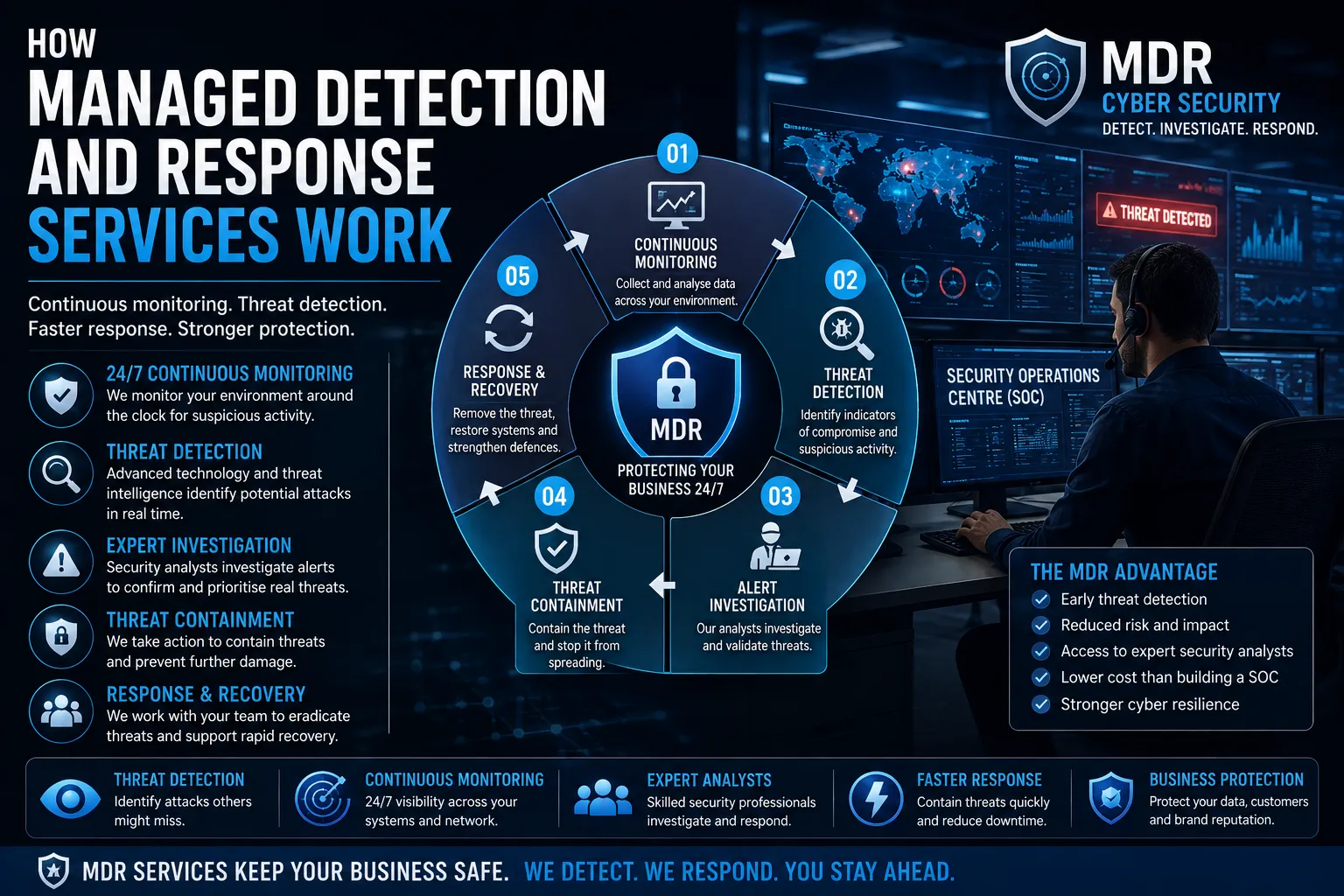
A typical MDR service operates continuously across several stages.
1. Continuous Security Monitoring
MDR platforms collect security data from sources such as endpoints, servers, networks, cloud environments and other business systems.
This information is analysed for unusual activity and potential indicators of compromise.
2. Threat Detection
Security technologies identify suspicious behaviour that may indicate malware, compromised accounts, ransomware or other cyber threats.
Detection can involve analysing events, authentication activity, endpoint behaviour and other security signals.
3. Alert Investigation
Security analysts investigate significant alerts to determine whether they represent genuine threats.
This human analysis helps distinguish legitimate activity from potentially malicious behaviour and reduces the burden of investigating security alerts internally.
4. Threat Containment
When a genuine threat is identified, response actions may be taken to contain the activity and prevent it from spreading.
Depending on the environment and service agreement, this may include isolating compromised endpoints, disabling accounts or blocking malicious activity.
5. Response and Recovery
MDR teams can work with internal staff or incident response specialists to contain the incident and support recovery.
The objective is to minimise disruption and prevent an attacker from maintaining access to business systems.
What Does MDR Monitor?
MDR services can monitor a wide range of systems and security events.
- Endpoints and workstations
- Servers
- Cloud environments
- Network activity
- User authentication
- Security events
- Suspicious processes
- Malware activity
The exact sources monitored depend on the MDR platform, business environment and scope of the service.
What Threats Can MDR Detect?
MDR is designed to identify a broad range of suspicious activity.
Ransomware
MDR can identify behavioural indicators associated with ransomware, including suspicious processes and unusual file activity.
Compromised Accounts
Unusual authentication patterns can indicate that an employee account has been compromised.
Malware
Endpoint monitoring can help identify malicious software and suspicious processes.
Unauthorised Activity
MDR can identify activity that differs from normal patterns and may indicate an attacker moving through an environment.
MDR vs Traditional Security Monitoring
Traditional security monitoring may rely heavily on internal teams responding to alerts generated by security tools.
MDR adds an additional layer of expertise by combining technology, continuous monitoring and security analysts.
| Traditional Monitoring | MDR |
|---|---|
| Security alerts | Continuous monitoring and detection |
| Internal investigation | Expert alert investigation |
| Often reactive | Detection and response focused |
| Requires internal resources | External security expertise |
MDR vs a Security Operations Centre
A Security Operations Centre (SOC) is a function dedicated to monitoring, detecting and responding to cyber security threats.
MDR is a managed service that provides organisations with external security monitoring and response capabilities.
In some cases, an MDR provider effectively extends an organisation’s security operations capability without requiring the business to build and staff its own SOC.
Learn more about Security Operations Centres.
Benefits of Managed Detection and Response
- Continuous monitoring: Security activity can be monitored around the clock.
- Faster threat detection: Suspicious activity can be identified earlier.
- Expert analysis: Security professionals investigate significant alerts.
- Reduced internal workload: Internal IT teams do not have to investigate every security event themselves.
- Improved ransomware detection: Behavioural monitoring can identify indicators associated with ransomware attacks.
- Faster response: Confirmed threats can be contained more quickly.
Does Your Business Need MDR?
MDR can be particularly valuable for organisations that do not have the resources to operate a fully staffed security monitoring function internally.
It may be appropriate for businesses that:
- Operate critical systems outside normal business hours
- Store sensitive customer information
- Have limited internal cyber security expertise
- Need continuous security monitoring
- Want additional protection against ransomware
- Require faster detection and response capabilities
How MDR Fits Into Your Cyber Security Strategy
MDR should work alongside other security controls rather than replace them.
- Security Operations Centre capabilities provide structured monitoring, detection and response.
- Incident Response provides a framework for containing and recovering from significant security incidents.
- Penetration Testing Results help identify vulnerabilities and demonstrate where attackers may be able to compromise systems.
Combining proactive security testing with continuous monitoring and incident response creates a stronger defence against evolving cyber threats.
Conclusion
Managed Detection and Response provides businesses with continuous security monitoring, expert threat detection and response capabilities without necessarily requiring them to build a large internal security team.
By detecting suspicious activity earlier, investigating potential threats and helping contain confirmed incidents, MDR can reduce the time attackers have to compromise systems and limit the impact of cyber attacks.
For organisations that need continuous protection but lack the resources to operate a dedicated security function internally, MDR can be an important component of a modern cyber security strategy.
FAQs
What are MDR services?
MDR services provide continuous cyber security monitoring, threat detection, investigation and response using security technology and expert security analysts.
What does MDR stand for in cyber security?
MDR stands for Managed Detection and Response. It is a managed security service designed to detect, investigate and respond to cyber threats.
What can MDR detect?
MDR can help detect threats such as ransomware, malware, compromised accounts, suspicious processes and other indicators of malicious activity.
What is the difference between MDR and a SOC?
A SOC is a security operations function responsible for monitoring and responding to threats, while MDR is a managed service that provides external monitoring, detection and response capabilities.