
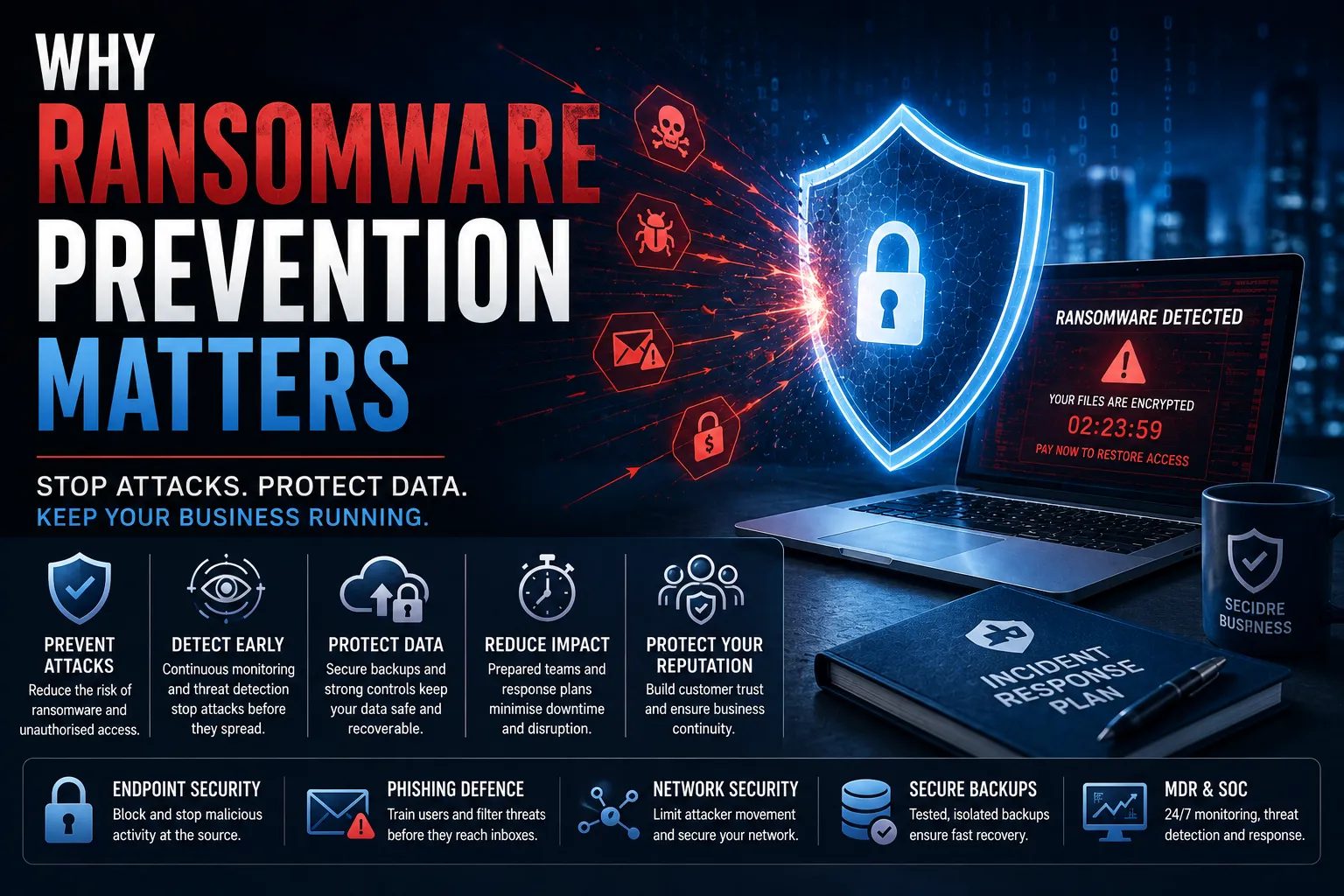
Introduction
Ransomware is one of the most disruptive cyber threats facing businesses today. A successful ransomware attack can prevent employees from accessing critical systems, encrypt business files, interrupt operations and create significant recovery costs.
While no organisation can completely eliminate cyber risk, effective ransomware prevention can make it substantially harder for attackers to gain access, spread through an environment and cause serious damage.
This guide explains why ransomware protection matters, how ransomware attacks typically occur and the security measures businesses can use to reduce their risk.
What Is Ransomware?
Ransomware is a type of malicious software designed to disrupt access to systems or data. In many attacks, criminals encrypt files and demand payment in exchange for supposedly restoring access.
Modern ransomware attacks can involve more than file encryption. Attackers may first compromise a network, steal sensitive information and move through business systems before deploying ransomware.
This means effective ransomware protection needs to address the attack before encryption takes place.
Why Ransomware Prevention Matters
The consequences of a ransomware attack can extend well beyond the initial technical incident.
Businesses may experience:
- Loss of access to critical files
- Business interruption and downtime
- Loss of customer data
- Expensive system recovery
- Reputational damage
- Regulatory and legal consequences
- Loss of customer confidence
For this reason, preventing ransomware is generally preferable to relying solely on recovery after an attack has already occurred.
How Do Ransomware Attacks Start?
Ransomware attacks can begin through several different attack vectors.
Phishing
Phishing emails can trick employees into opening malicious attachments, visiting fraudulent websites or providing credentials to attackers.
Stolen Credentials
Compromised usernames and passwords can provide attackers with an initial foothold into business systems, particularly where multi-factor authentication is not enabled.
Unpatched Vulnerabilities
Attackers can exploit vulnerabilities in operating systems, applications, network devices and internet-facing services to gain unauthorised access.
Remote Access
Poorly secured remote access services can provide attackers with another pathway into an organisation’s network.
Essential Ransomware Prevention Measures
1. Protect Endpoints
Endpoint security helps protect computers, laptops and servers against malicious software and suspicious activity.
Modern endpoint security can detect unusual processes and behaviours that may indicate an emerging ransomware attack.
2. Use Multi-Factor Authentication
Multi-factor authentication adds an additional layer of protection if a password is compromised.
Businesses should prioritise MFA for email, cloud platforms, remote access and privileged accounts.
3. Keep Systems Patched
Regularly applying security updates reduces exposure to vulnerabilities that attackers may use to gain access to business systems.
4. Maintain Secure Backups
Backups are an essential part of ransomware resilience. However, backups should not simply be connected copies of production data.
Businesses should maintain appropriately protected backups and regularly test their ability to restore critical systems and information.
5. Train Employees
Employees are an important part of ransomware prevention. Regular security awareness training can help staff recognise phishing emails, suspicious attachments and other common attack techniques.
How MDR and a SOC Help Prevent Ransomware
Security tools may identify suspicious activity, but organisations also need visibility and expertise to investigate potential threats.
Managed Detection and Response (MDR) services can provide continuous monitoring and expert investigation of suspicious activity.
A Security Operations Centre (SOC) can monitor security events, investigate potential threats and coordinate responses when malicious activity is detected.
Early detection is particularly important because attackers may spend time moving through a network before deploying ransomware.
Network and Cloud Security
Ransomware prevention should extend across the entire technology environment.
Network Security controls can help limit unauthorised access and restrict an attacker’s ability to move between systems.
Cloud Security is equally important as businesses increasingly store critical files and applications in cloud environments.
Strong identity controls, appropriate permissions, monitoring and secure configurations can help reduce opportunities for attackers to compromise cloud resources.
Why Incident Response Still Matters
Even with strong ransomware protection, organisations should prepare for the possibility that an attack will succeed.
An Incident Response plan establishes what the organisation should do when a security incident occurs.
This can include:
- Identifying and containing the attack
- Isolating compromised systems
- Preserving evidence
- Investigating the attack
- Restoring systems from secure backups
- Communicating with affected stakeholders
Preparation can significantly reduce confusion and downtime during a serious cyber incident.
How This Fits Into Your Cyber Security Strategy
Effective ransomware prevention requires multiple layers of protection rather than one security product.
A resilient strategy should combine:
- Endpoint security
- Network security
- Cloud security
- Multi-factor authentication
- Security monitoring
- MDR and SOC capabilities
- Employee security awareness
- Secure and tested backups
- Incident response planning
These measures work together to prevent attacks, detect suspicious activity earlier and reduce the impact when incidents occur.
Conclusion
Ransomware attacks can cause significant financial, operational and reputational damage. Prevention therefore needs to be a core part of every organisation’s cyber security strategy.
By securing endpoints, protecting networks and cloud environments, training employees, maintaining reliable backups and implementing continuous security monitoring, businesses can make ransomware attacks substantially more difficult to execute.
And if an attacker does get through, a well-prepared incident response capability can help contain the threat and accelerate recovery.
FAQs
What is ransomware prevention?
Ransomware prevention involves implementing security controls and processes designed to stop ransomware attacks before they can compromise systems, encrypt data or disrupt business operations.
How can businesses protect against ransomware?
Businesses can reduce ransomware risk through endpoint security, MFA, regular patching, employee training, secure backups, network security, cloud security and continuous security monitoring.
Can MDR help prevent ransomware attacks?
MDR can help identify suspicious activity associated with ransomware attacks and provide expert investigation and response, potentially allowing threats to be contained before significant damage occurs.
Why are backups important for ransomware protection?
Secure, tested backups can allow businesses to restore critical systems and data without relying solely on an attacker to provide access after an encryption event.