
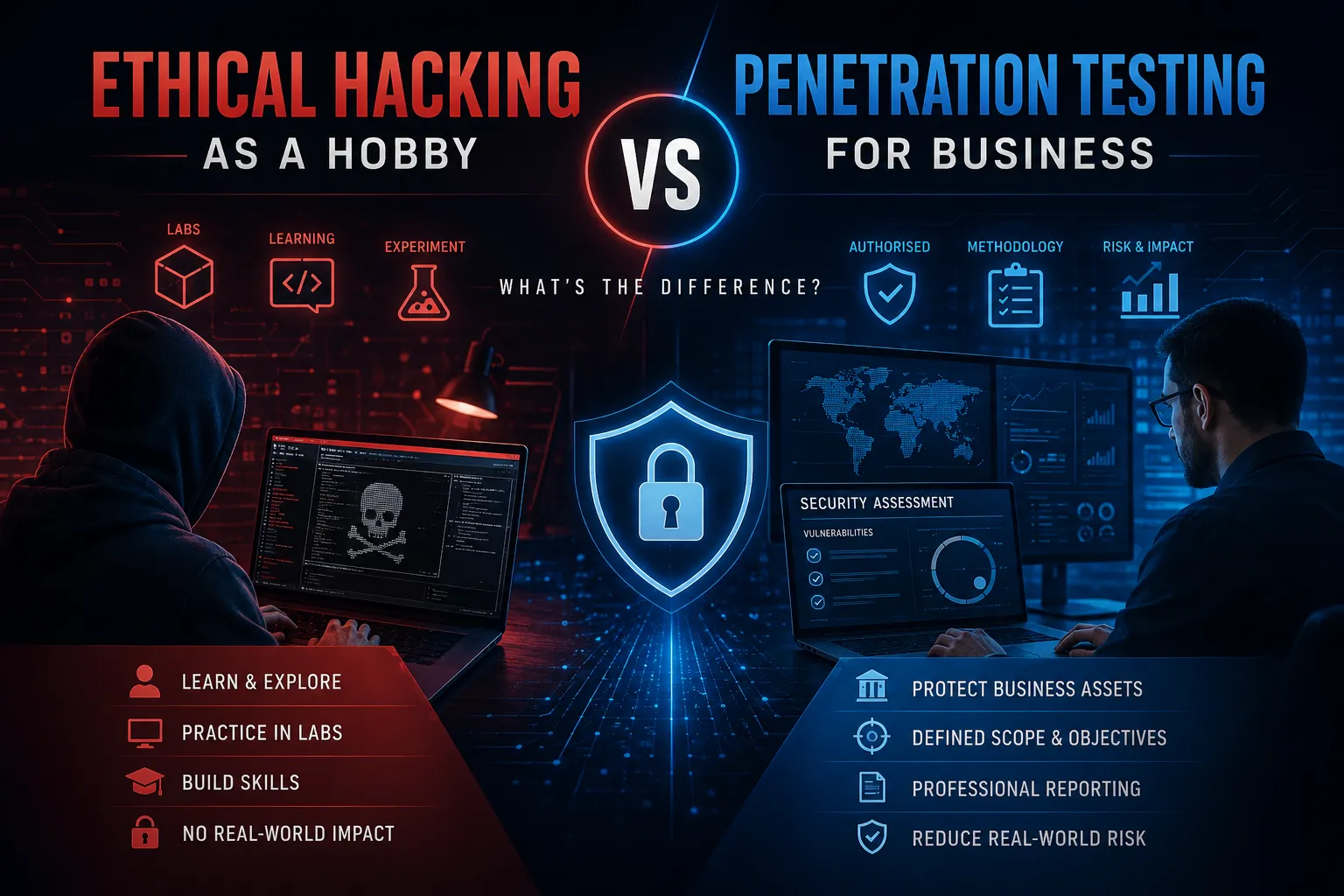
The terms ethical hacking and penetration testing are often used interchangeably. While they share many of the same techniques, there is an important difference between experimenting with ethical hacking as a hobby and conducting a professional penetration test for a business.
Someone learning ethical hacking at home might spend their evenings exploring vulnerable machines, learning how networks work, analysing applications or practising with security tools. That’s a great way to develop cybersecurity skills.
A corporate penetration test, however, involves much more than knowing how to exploit a vulnerability.
Professional penetration testing requires authorisation, defined objectives, careful planning, appropriate methodologies, evidence-based reporting and an understanding of the potential impact on a live business environment.
So, while a hobbyist ethical hacker and a professional penetration tester may use some of the same tools and techniques, the purpose, environment, responsibilities and standards involved are very different.
What Is Hobbyist Ethical Hacking?
Ethical hacking as a hobby can be an excellent way to learn about cybersecurity.
A hobbyist might set up a virtual lab at home, use intentionally vulnerable applications or participate in cybersecurity training platforms and capture-the-flag challenges.
They may practise techniques such as:
- Network reconnaissance
- Port and service enumeration
- Vulnerability discovery
- Web application testing
- Password security testing
- Privilege escalation
- Exploit development
- Digital forensics
- Malware analysis
- Network traffic analysis
The goal is generally learning and experimentation.
A hobbyist can safely explore how attacks work without putting another person’s systems, data or business operations at risk, provided they stay within environments they own or have explicit permission to test.
That last point is critical.
Ethical Hacking Doesn’t Mean You Can Hack Anything
The word “ethical” doesn’t automatically make an activity legal.
Testing a computer, website, server, wireless network or application without permission can have serious consequences, even if the intention is simply to demonstrate a security weakness.
Someone learning ethical hacking should therefore practise using systems specifically designed for security training, their own laboratory environments or systems where they have explicit authorisation to conduct testing.
For example, deliberately vulnerable virtual machines and cybersecurity training platforms provide a safe environment in which to learn how attacks work.
The skills developed in these environments can eventually form the foundation for a career in penetration testing.
What Is Corporate Penetration Testing?
Corporate penetration testing is a professional security assessment designed to determine whether an organisation’s systems can be compromised by an attacker.
Unlike hobbyist hacking, a corporate penetration test takes place within a clearly defined engagement.
Before testing begins, the organisation and penetration-testing provider establish the scope, objectives, rules and limitations of the assessment.
Depending on the engagement, this could include:
- External network infrastructure
- Internal corporate networks
- Web applications
- Mobile applications
- APIs
- Cloud environments
- Wireless networks
- Specific servers or applications
- Authentication systems
- Other business-critical infrastructure
The penetration tester then uses a combination of automated tools, manual testing and professional expertise to identify and validate vulnerabilities.
The objective isn’t simply to “hack the system”.
It’s to answer a business question:
Could an attacker exploit this weakness, and what would happen if they did?
Hobbyist Hacking vs Corporate Penetration Testing
The differences become clearer when the two activities are compared directly.
| Hobbyist Ethical Hacking | Corporate Penetration Testing |
|---|---|
| Primarily focused on learning and experimentation | Focused on assessing business security |
| Usually performed in a lab or authorised training environment | Performed against authorised business systems |
| Scope may be informal | Scope is formally defined |
| Mistakes generally affect the individual’s own environment | Mistakes can affect live business systems |
| May focus heavily on technical exploitation | Combines technical testing with risk and business impact |
| Results may be informal notes or findings | Requires professional documentation and reporting |
| No client relationship | Conducted for a client or organisation |
| Usually no contractual obligations | Governed by agreements, rules of engagement and confidentiality requirements |
| Learning is often the primary objective | Risk reduction is the primary objective |
| Testing can be exploratory | Testing must remain controlled and within scope |
The technical skills can overlap, but professional penetration testing adds a substantial layer of responsibility around those skills.
The Importance of Authorisation
One of the biggest differences between hobbyist experimentation and corporate penetration testing is authorisation.
A professional penetration tester has permission to test the systems included in the engagement.
That permission should be clearly established before testing begins.
For a corporate penetration test, the scope might specify particular IP addresses, domains, applications, accounts or cloud resources that can be assessed.
It may also specify techniques that are prohibited or require additional approval.
For example, an organisation may permit vulnerability exploitation but prohibit denial-of-service testing because disrupting a production system could affect customers.
A professional tester must understand these boundaries and work within them.
A Corporate Penetration Test Has a Defined Scope
When learning ethical hacking, it’s easy to follow an interesting vulnerability wherever it leads.
Professional penetration testing is different.
The tester needs to understand exactly what is in scope and what isn’t.
A test might be limited to:
External infrastructure
The tester assesses systems that are accessible from the internet, looking for weaknesses that could provide an attacker with an entry point.
Internal infrastructure
The assessment simulates what could happen if an attacker gained access to the internal network, potentially through compromised credentials or another initial foothold.
Web applications
The tester examines an application for vulnerabilities involving authentication, authorisation, input validation, session management and other security controls.
APIs
APIs can expose sensitive functionality and data, making them an important part of modern application security testing.
Mobile applications
Mobile apps can be assessed alongside their supporting APIs and backend infrastructure.
Wireless networks
Wireless security testing can identify weaknesses in authentication, configuration and network access controls.
The scope determines what the penetration tester is trying to achieve and prevents testing from becoming uncontrolled.
Professional Penetration Testing Is More Than Running Tools
One common misconception is that penetration testing involves running a collection of security tools and reporting whatever they find.
Tools are certainly important, but they are only part of the process.
Automated scanners can identify potentially vulnerable software, exposed services and configuration issues. A skilled penetration tester then needs to determine whether those findings are genuinely exploitable and what they mean in context.
For example, a scanner might identify a potentially vulnerable service.
A professional tester may investigate:
- Whether the service is actually accessible.
- Whether the identified vulnerability applies to the installed version.
- Whether exploitation is possible.
- What privileges exploitation could provide.
- Whether the compromised system can be used to access another system.
- Whether sensitive information could be reached.
- What the potential business impact would be.
This is where experience becomes particularly important.
Finding a vulnerability and understanding its significance are two different things.
Professional Testing Has to Consider Business Risk
A hobbyist might be interested in whether they can obtain administrator access to a test machine.
A business needs to know what that access means.
Could an attacker:
- Access customer information?
- Steal confidential documents?
- Compromise employee accounts?
- Move to other systems?
- Access financial information?
- Deploy ransomware?
- Modify business applications?
- Disrupt critical operations?
Professional penetration testing therefore connects technical findings with business risk.
A vulnerability isn’t important simply because it has a high technical severity score. Its importance also depends on the systems affected, the data available, the likelihood of exploitation and what an attacker could achieve.
Reporting Is a Major Part of Professional Penetration Testing
A hobbyist may discover a vulnerability and move on to the next challenge.
A professional penetration tester has to communicate the findings to the organisation.
A penetration-testing report will generally document:
- The scope of the assessment
- Testing methodology
- Vulnerabilities identified
- Evidence of exploitation
- Severity and risk
- Affected systems
- Potential business impact
- Recommended remediation
- Supporting technical information
The report needs to be useful to different people within the organisation.
A security professional may need the technical details required to reproduce and fix a vulnerability, while a business leader may primarily need to understand the risk and prioritisation.
This ability to communicate technical security findings clearly is a fundamental part of professional penetration testing.
Professional Testers Also Have to Manage Risk
Testing a deliberately vulnerable machine in a home lab is very different from testing a live production environment.
A corporate system may be supporting hundreds or thousands of employees or customers.
An aggressive testing technique that is harmless in a training environment could potentially cause an outage in production.
Professional penetration testers therefore need to consider the potential consequences of their actions throughout an engagement.
This is another reason why penetration testing isn’t simply a matter of knowing which commands or exploits to run.
The tester needs to know when to test, how far to go and when to stop.
Can a Hobbyist Become a Professional Penetration Tester?
Absolutely.
In fact, experimentation and self-directed learning can be valuable ways to develop the technical foundation required for a career in penetration testing.
Many security professionals spend years developing skills through:
- Cybersecurity labs
- Capture-the-flag competitions
- Security research
- Programming
- Networking
- Operating systems
- Web application security
- Vulnerability research
- Security certifications
- Practical testing experience
The important distinction is that being good at hacking doesn’t automatically mean someone is ready to perform penetration testing for a business.
Professional testers need technical skills as well as an understanding of methodology, risk management, communication, documentation and professional conduct.
What Makes a Professional Penetration Tester Different?
A professional penetration tester needs to combine several skill sets.
Technical expertise
They need to understand networks, operating systems, applications, authentication, cloud environments and common attack techniques.
Security methodology
They need a structured approach for discovering, validating and documenting vulnerabilities.
Risk awareness
They need to understand the potential consequences of their testing and distinguish between a technical weakness and a meaningful business risk.
Communication
They need to explain technical findings to people who may not have a cybersecurity background.
Professional judgement
Perhaps most importantly, they need to know how to test safely.
The ability to exploit a vulnerability is only one part of the job.
Knowing whether you should exploit it, how far you should go and how to demonstrate the risk without unnecessarily disrupting the organisation is equally important.
Why Businesses Should Use Professional Penetration Testing
For a business, penetration testing is an investment in understanding its real-world security exposure.
A professional assessment can help identify weaknesses that may otherwise remain unnoticed and provide evidence of how those weaknesses could potentially be exploited.
It can also help organisations:
- Prioritise security improvements
- Validate security controls
- Identify exploitable vulnerabilities
- Reduce attack surface
- Support security and compliance programs
- Test newly deployed systems
- Assess applications before release
- Understand potential attack paths
- Improve incident preparedness
The objective isn’t to prove that a business is impossible to hack — no security assessment can provide that guarantee.
Instead, penetration testing provides a controlled way to identify and address weaknesses before a malicious attacker finds them.
From Ethical Hacking Hobbyist to Professional Penetration Tester
Ethical hacking and penetration testing share a common foundation, but the environment in which those skills are applied makes a significant difference.
A hobbyist can use ethical hacking to learn how attacks work, explore vulnerabilities and develop valuable cybersecurity skills. When those techniques are applied to a real organisation, however, they need to be backed by explicit authorisation, defined scope, professional methodology, risk management and clear reporting.
In other words:
Hobbyist ethical hacking teaches you how attackers think. Professional penetration testing applies those skills in a controlled environment to help businesses understand and reduce their security risk.
For organisations considering a penetration test, choosing an experienced professional security provider ensures that testing is conducted safely, systematically and with the needs of the business in mind.
IST Cyber provides professional penetration testing services for Australian organisations, including testing of networks, web applications, APIs, mobile applications and wireless environments.
If you want to understand how a professional penetration test works in more detail, see our guide to what penetration testing is, or learn more about penetration testing costs in Australia.