
Cybersecurity is no longer just an IT problem. For modern businesses, security decisions can affect everything from regulatory obligations and customer trust to financial performance, business continuity and the organisation’s reputation.
This is where cyber governance, risk and compliance (GRC) comes in.
GRC provides a structured way for organisations to manage cybersecurity risk, establish accountability and make sure their security practices align with business objectives and relevant legal or regulatory requirements. Rather than treating cybersecurity as a collection of disconnected technical controls, GRC helps bring people, processes, policies and technology together under a common framework.
For organisations researching IT governance, risk and compliance, understanding how these three areas work together is an important first step towards building a more mature cybersecurity program.
What Does Cyber GRC Mean?
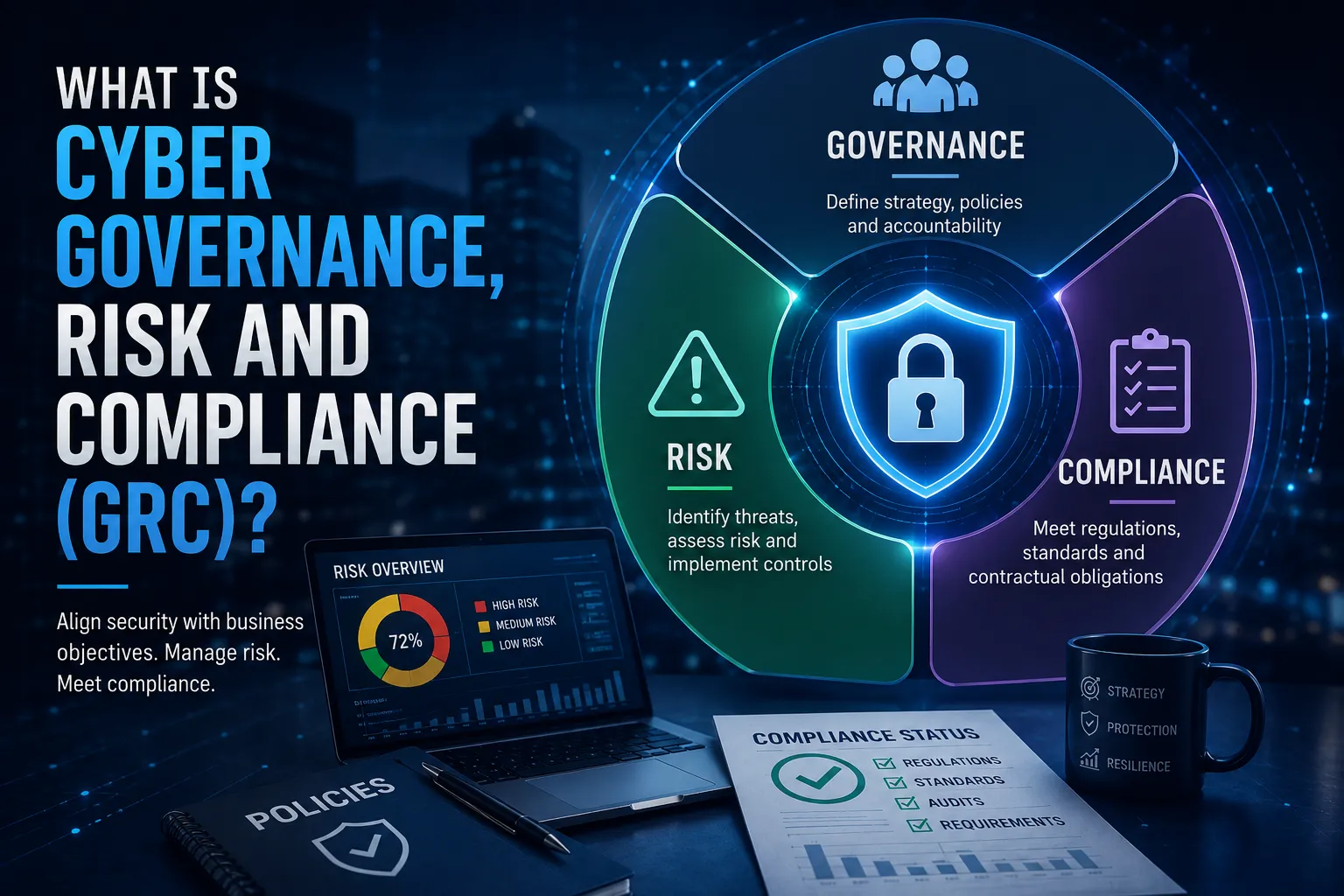
The term GRC stands for:
- Governance – how an organisation directs and oversees its cybersecurity activities
- Risk – how cybersecurity threats are identified, assessed and managed
- Compliance – how the organisation demonstrates that it meets applicable laws, regulations, standards and contractual obligations
These areas are closely connected.
Good governance establishes who is responsible for security and how decisions are made. Risk management identifies what could go wrong and determines which risks require attention. Compliance ensures that the organisation understands and meets the requirements that apply to its operations.
Together, they provide a framework for making cybersecurity more consistent, measurable and accountable.
What Is Cyber Governance?
Cyber governance is the process of establishing oversight, responsibility and direction for cybersecurity within an organisation.
It answers questions such as:
- Who is responsible for cybersecurity?
- Who makes security decisions?
- What level of cyber risk is the organisation willing to accept?
- Which security policies should employees follow?
- How is cybersecurity performance measured?
- How are security issues reported to management?
- How does cybersecurity support wider business objectives?
Without effective governance, security can become reactive.
An organisation may invest heavily in security technology but still lack clear ownership of risks, consistent policies or an agreed process for deciding which vulnerabilities should be addressed first.
Effective governance helps ensure cybersecurity is treated as a business responsibility rather than something delegated entirely to the IT department.
Cybersecurity Policies and Standards
Policies are an important part of governance.
Depending on the organisation, these might cover:
- Information security
- Acceptable technology use
- Passwords and authentication
- Access control
- Remote working
- Incident response
- Data protection
- Third-party security
- Business continuity
- Vulnerability management
- Security testing
Policies should not simply exist as documents that employees never read. They need to be communicated, implemented, reviewed and updated as the organisation’s technology and risk environment changes.
What Is Cybersecurity Risk Management?
Cybersecurity risk management focuses on understanding threats and vulnerabilities and determining how they could affect the organisation.
Every organisation faces some level of cyber risk. The objective isn’t necessarily to eliminate every possible risk — which is generally unrealistic — but to understand the most significant risks and manage them appropriately.
A typical risk management process may involve:
- Identifying assets
- Identifying threats
- Identifying vulnerabilities
- Assessing potential consequences
- Determining likelihood
- Calculating or assigning risk
- Selecting appropriate controls
- Monitoring the remaining risk
- Reviewing and reassessing risks over time
For example, an organisation may identify a customer database as a critical asset.
The risk assessment could consider what might happen if an attacker gained unauthorised access to that database, how likely such an incident might be and what controls are currently in place to prevent it.
The resulting risk can then be prioritised alongside other business risks.
Why Cyber Risk Needs to Be Connected to Business Risk
One of the most important aspects of GRC is putting cybersecurity into a broader business context.
A technical vulnerability is not necessarily a business-critical risk simply because a security scanner assigns it a high severity rating.
Conversely, a vulnerability with a seemingly moderate technical rating could represent a significant business risk if it affects a critical system, contains sensitive information or provides an attacker with a pathway into the wider environment.
Effective cyber risk management therefore considers questions such as:
- What business process does the system support?
- What information does it contain?
- Could an attacker use the vulnerability to access other systems?
- Would an outage affect customers?
- Are there regulatory consequences?
- Could the incident result in financial losses?
- How quickly could the organisation recover?
This allows decision-makers to prioritise security investments according to business impact rather than technical severity alone.
What Is Cybersecurity Compliance?
Cybersecurity compliance involves meeting requirements established by laws, regulations, industry standards, contractual obligations or other applicable frameworks.
The requirements vary depending on the organisation’s industry, customers, location and activities.
For Australian organisations, compliance considerations may include areas such as:
- Privacy and protection of personal information
- Industry-specific regulatory requirements
- Contractual security requirements
- Government security requirements
- Cybersecurity frameworks and standards
- Customer or supplier security requirements
Compliance should not be confused with security itself.
An organisation can technically meet a particular compliance requirement and still have cybersecurity weaknesses.
Likewise, implementing strong security controls does not necessarily mean an organisation automatically meets every regulatory or contractual obligation that applies to it.
The purpose of GRC is to bring these considerations together.
GRC vs Cybersecurity: What’s the Difference?
Cybersecurity and GRC overlap, but they aren’t exactly the same.
Cybersecurity focuses primarily on protecting systems, networks, applications, devices and information from threats.
GRC provides the organisational structure around those activities.
For example, a cybersecurity team might deploy multi-factor authentication across the organisation.
The GRC function can help establish:
- Why MFA is required
- Which systems must use it
- Who is responsible for implementing it
- What policy requires it
- How compliance is measured
- What risks exist if it isn’t implemented
- How exceptions are approved
- How management receives reports about the control
In this sense, cybersecurity is concerned with how systems are protected, while GRC helps establish why controls are required, who is responsible for them and how their effectiveness is governed and demonstrated.
The Three Components of Cyber GRC
Although governance, risk and compliance are closely related, each has a distinct role.
1. Governance
Governance establishes the organisation’s security direction.
It includes:
- Policies
- Roles and responsibilities
- Security objectives
- Accountability
- Management oversight
- Security strategy
- Reporting
- Decision-making processes
Good governance makes it clear who owns cybersecurity risks and who has authority to make decisions.
2. Risk
Risk management identifies and prioritises potential threats to the organisation.
This can include risks relating to:
- Cyber attacks
- Data breaches
- Ransomware
- Vulnerabilities
- Cloud environments
- Third-party suppliers
- Employees
- Operational technology
- Business continuity
- Shadow IT
The organisation can then determine which risks need to be avoided, reduced, transferred or formally accepted.
3. Compliance
Compliance ensures the organisation understands and meets the requirements relevant to its circumstances.
This may involve:
- Identifying applicable requirements
- Mapping controls against those requirements
- Collecting evidence
- Performing assessments
- Addressing gaps
- Maintaining documentation
- Reporting compliance status
- Reviewing requirements as they change
Keeping these three areas connected can make cybersecurity management considerably more effective.
What Does an IT Governance, Risk and Compliance Program Involve?
An IT governance, risk and compliance program can encompass a wide range of activities.
The exact structure depends on the organisation, but a mature program might include:
Risk Assessments
Regular assessments help identify changes in the organisation’s threat and risk environment.
Security Policies
Policies establish clear expectations for employees, management and technology teams.
Control Frameworks
Frameworks can provide a structured way to identify and manage security controls.
Risk Registers
A risk register records identified risks, their owners, ratings, treatment plans and current status.
Compliance Assessments
Assessments can determine whether existing controls meet relevant regulatory, contractual or framework requirements.
Third-Party Risk Management
Suppliers and technology providers can introduce additional risks. GRC can establish processes for assessing and monitoring those risks.
Security Audits
Audits can provide an independent review of whether policies and controls are operating as intended.
Incident Management
GRC can also help establish how significant cybersecurity incidents are escalated, documented and reviewed.
Management Reporting
Security information needs to reach the people responsible for making business decisions. GRC can turn technical findings into meaningful management-level reporting.
Common Cybersecurity GRC Frameworks
Organisations can use a variety of standards and frameworks to structure their GRC programs.
The appropriate framework depends on the organisation’s objectives and circumstances.
Some commonly encountered frameworks and standards include:
NIST Cybersecurity Framework
The NIST Cybersecurity Framework provides a structured approach to managing cybersecurity risk and is widely used by organisations internationally.
ISO/IEC 27001
ISO 27001 provides requirements for establishing, implementing, maintaining and continually improving an information security management system.
It can be particularly useful for organisations seeking a formal information security management structure and, where appropriate, certification.
Essential Eight
The Australian Government’s Essential Eight provides a practical set of mitigation strategies designed to help organisations protect against common cyber threats.
For Australian businesses, the Essential Eight can be an important part of a broader security and risk management strategy.
However, it shouldn’t automatically be treated as a complete GRC program. Governance, risk management, policies, accountability and broader compliance requirements may extend well beyond the individual controls.
What Are the Benefits of Cyber GRC?
A structured GRC approach can provide several benefits.
Better Visibility of Cyber Risk
Instead of having security risks scattered across different teams and systems, GRC can provide a central view of the organisation’s risk profile.
Clearer Accountability
GRC establishes who owns particular risks, controls and security responsibilities.
More Consistent Security
Policies and standards help ensure that security practices are applied consistently rather than depending on individual employees or departments.
Improved Compliance Management
Organisations can better understand which requirements apply to them and identify gaps before they become larger problems.
Better Security Investment Decisions
When cybersecurity risks are linked to business objectives, organisations can make more informed decisions about where security resources should be invested.
Stronger Management Reporting
GRC helps translate technical security information into information that executives and boards can use to make decisions.
Reduced Business Risk
Ultimately, the purpose of GRC is to help organisations understand and reduce the risks that could affect their operations, customers, employees and reputation.
Is GRC Only for Large Organisations?
Not necessarily.
Large organisations often have dedicated GRC teams because their environments and regulatory obligations can be complex. However, smaller and medium-sized businesses can also benefit from applying GRC principles.
A smaller organisation might not need a dedicated GRC department.
Instead, it could establish a practical structure covering:
- Security policies
- Risk assessments
- Asset management
- Access controls
- Incident response
- Security awareness
- Compliance obligations
- Supplier risk
- Vulnerability management
- Regular security reviews
The important thing is to establish a level of governance and risk management appropriate to the organisation’s size, complexity and risk profile.
What Happens Without Effective Cyber GRC?
When cybersecurity governance is weak, organisations can struggle to understand who is responsible for managing particular risks.
This can lead to problems such as:
- Security policies becoming outdated
- Risks not being assigned to an owner
- Vulnerabilities remaining unresolved
- Inconsistent security practices
- Poor visibility of third-party risks
- Compliance gaps
- Unclear incident responsibilities
- Security spending without clear priorities
- Difficulty demonstrating that controls are working
Technology alone cannot solve these problems.
An organisation can have sophisticated security products in place and still lack the governance needed to use them effectively.
How Does GRC Support Cybersecurity Testing?
GRC and technical security testing should work together.
For example, a penetration test might identify a vulnerability in an organisation’s network.
From a technical perspective, the penetration testing team can explain how the vulnerability was discovered, exploited and what an attacker could potentially achieve.
From a GRC perspective, the organisation can then determine:
- Who owns the risk?
- How serious is the business impact?
- Does the vulnerability create a compliance issue?
- How quickly should it be remediated?
- What compensating controls exist?
- Has remediation been completed?
- Does the system need to be retested?
This creates a feedback loop between technical security and organisational risk management.
Building a Practical Cyber GRC Strategy
A GRC program doesn’t need to be unnecessarily complicated.
A practical starting point is to establish a clear understanding of the organisation’s assets, risks, obligations and responsibilities.
From there, organisations can:
1. Identify critical assets
Determine which systems, information and business processes are most important.
2. Identify cybersecurity risks
Consider the threats and vulnerabilities that could affect those assets.
3. Understand compliance obligations
Identify the laws, standards, contractual requirements and industry obligations that apply.
4. Establish security policies
Document the controls and behaviours expected across the organisation.
5. Assign responsibility
Every significant risk and control should have appropriate ownership.
6. Assess existing controls
Determine whether current security measures adequately address identified risks.
7. Prioritise gaps
Focus resources on the issues that present the greatest business risk.
8. Monitor and review
Cybersecurity risks change over time, so GRC should be an ongoing process rather than a once-a-year exercise.
Cyber GRC Is an Ongoing Process
Cybersecurity governance, risk and compliance isn’t something an organisation completes once and then forgets about.
Technology changes. New vulnerabilities emerge. Regulations evolve. Employees join and leave. Suppliers change. Businesses introduce new systems and services.
As the organisation changes, its cybersecurity risk profile changes with it.
A mature GRC program therefore involves continuous review, measurement and improvement.
The goal isn’t to create an enormous collection of policies and spreadsheets. It is to establish a practical system that helps the organisation understand its risks, meet its obligations and make better cybersecurity decisions.
How Can a Cybersecurity Consultant Help With GRC?
Developing a GRC program can be challenging when organisations don’t have the internal expertise or resources to assess their security posture objectively.
A cybersecurity consultant can help organisations identify risks, assess existing controls, develop security policies, map requirements to controls and establish a structured approach to cybersecurity governance.
External expertise can also provide an independent perspective on whether existing security measures are appropriate for the organisation’s actual risk profile.
For businesses that are growing, preparing for regulatory or customer requirements, undergoing an audit or trying to improve their overall cybersecurity maturity, this can be particularly valuable.
The Bottom Line
Cyber governance, risk and compliance provides the framework that connects cybersecurity with business decision-making.
Governance establishes accountability and direction. Risk management identifies and prioritises potential threats. Compliance ensures the organisation understands and meets the requirements that apply to it.
Together, these elements can help organisations move away from reactive cybersecurity and towards a more structured, risk-based approach.
For organisations researching IT governance, risk and compliance, the key is not simply to accumulate policies or tick compliance boxes. Effective GRC should help the business understand its most important cyber risks, determine how those risks should be managed and continually improve its security posture.
When governance, risk management and technical cybersecurity work together, organisations are in a much stronger position to protect their systems, information and customers while making informed decisions about cybersecurity investment.