
Introduction
Web applications are one of the most common targets for cyber attacks. To help organisations understand the most critical application security risks, the Open Web Application Security Project (OWASP) created the OWASP Top 10.
The OWASP Top 10 is widely recognised as a key benchmark for application security.
So, what is the OWASP Top 10, and why does it matter?
This guide explains the OWASP Top 10 categories with real-world examples and practical security insights.
What is the OWASP Top 10?
The OWASP Top 10 is a regularly updated list of the most critical web application security risks.
It helps organisations:
- Understand common attack methods
- Improve application security practices
- Prioritise remediation efforts
- Reduce exposure to cyber threats
The framework is used globally by developers, security teams and penetration testers.
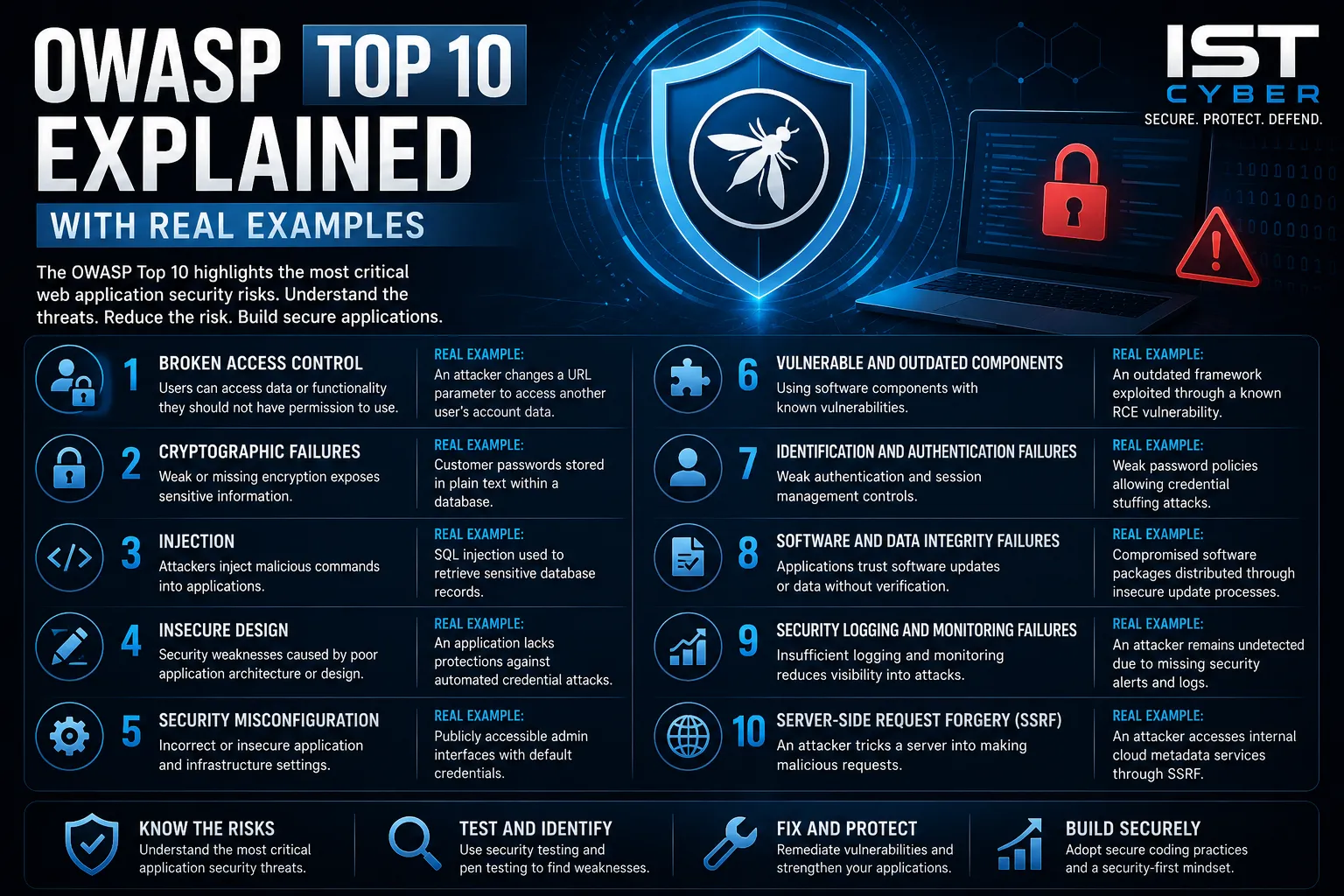
OWASP Top 10 Explained
1. Broken Access Control
Occurs when users can access data or functionality they should not have permission to use.
Real example:
An attacker changes a URL parameter to access another user’s account data.
2. Cryptographic Failures
Weak or missing encryption exposes sensitive information.
Real example:
Customer passwords stored in plain text within a database.
3. Injection
Attackers inject malicious commands into applications.
Real example:
SQL injection used to retrieve sensitive database records.
4. Insecure Design
Security weaknesses caused by poor application architecture or design.
Real example:
An application lacks protections against automated credential attacks.
5. Security Misconfiguration
Incorrect or insecure application and infrastructure settings.
Real example:
Publicly accessible admin interfaces with default credentials.
6. Vulnerable and Outdated Components
Using software components with known vulnerabilities.
Real example:
An outdated framework exploited through a known remote code execution vulnerability.
7. Identification and Authentication Failures
Weak authentication and session management controls.
Real example:
Weak password policies allowing credential stuffing attacks.
8. Software and Data Integrity Failures
Applications trust software updates or data without verification.
Real example:
Compromised software packages distributed through insecure update processes.
9. Security Logging and Monitoring Failures
Insufficient logging and monitoring reduces visibility into attacks.
Real example:
An attacker remains undetected due to missing security alerts.
10. Server-Side Request Forgery (SSRF)
An attacker tricks a server into making malicious requests.
Real example:
An attacker accesses internal cloud metadata services through SSRF.
Why the OWASP Top 10 Matters
The OWASP Top 10 helps organisations focus on the risks most commonly exploited by attackers.
Key benefits:
- Improves application security awareness
- Guides secure development practices
- Supports penetration testing and assessments
- Helps prioritise remediation efforts
How Businesses Reduce OWASP Risks
- Implement secure coding practices
- Conduct regular penetration testing
- Use application security testing tools
- Patch vulnerable systems promptly
- Monitor and log suspicious activity
Continuous testing and monitoring are critical for reducing application security risk.
How This Fits into Cyber Security Strategy
The OWASP Top 10 is a core component of modern application security programs.
- Application Security testing and hardening
- Penetration Testing for identifying exploitable weaknesses
- Secure software development practices
- Threat detection and monitoring
These controls help organisations reduce application-layer attack exposure.
Conclusion
So, what is the OWASP Top 10?
It’s a globally recognised framework outlining the most critical web application security risks.
By understanding these risks, organisations can:
- Improve application security
- Reduce exploitable vulnerabilities
- Strengthen secure development practices
- Protect sensitive data and systems
FAQs
What is the OWASP Top 10?
The OWASP Top 10 is a list of the most critical web application security risks.
Why is the OWASP Top 10 important?
It helps organisations understand and reduce common application security risks.
How often is the OWASP Top 10 updated?
It is periodically updated to reflect evolving threats and attack trends.
Who uses the OWASP Top 10?
Developers, security professionals and penetration testers use it worldwide.
Leave a Reply