
Introduction
As organisations increasingly rely on software to power their operations, securing applications during development has become critical. One of the most effective ways to identify vulnerabilities early is through Static Application Security Testing (SAST).
But what is SAST, and how does it actually work?
This guide explains SAST in simple terms, how it fits into modern development workflows, and why it plays a key role in application security.
What is SAST?
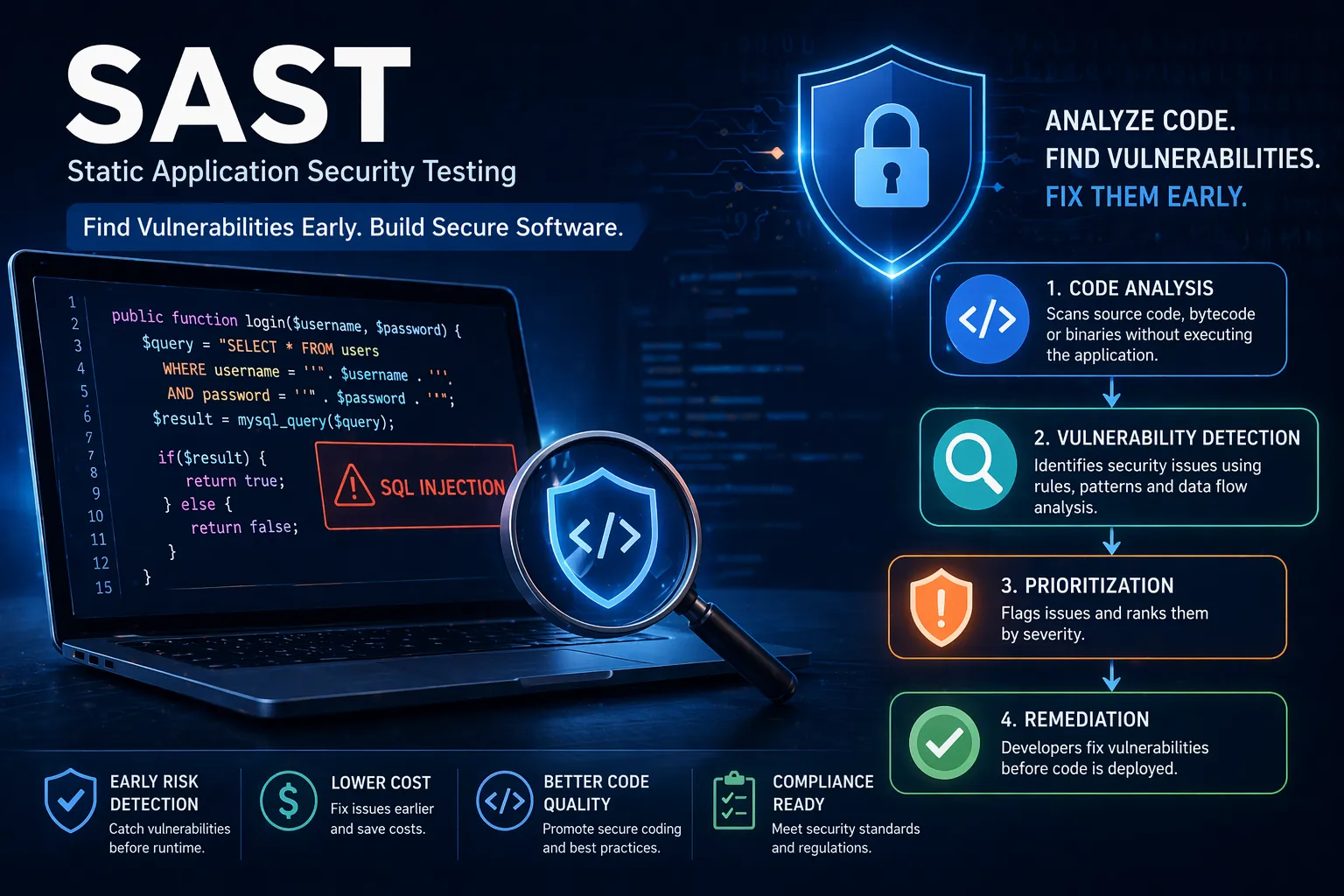
SAST (Static Application Security Testing) is a method of analysing source code, bytecode or binaries to identify security vulnerabilities without executing the application.
In other words, SAST scans your code before it runs to detect issues such as:
- SQL injection vulnerabilities
- Cross-site scripting (XSS) risks
- Insecure authentication logic
- Hardcoded credentials
- Misconfigured security controls
Because SAST works at the code level, it allows developers to identify and fix issues early in the development lifecycle.
How Does SAST Work?
SAST tools analyse code using a combination of rules, pattern matching and data flow analysis to identify potential vulnerabilities.
Step 1: Code Analysis
The tool scans source code or compiled code to understand its structure and logic.
Step 2: Pattern Matching
It compares code against known vulnerability patterns (e.g. unsafe input handling).
Step 3: Data Flow Analysis
The tool tracks how data moves through the application to identify insecure flows (e.g. user input reaching a database without validation).
Step 4: Vulnerability Identification
Potential issues are flagged and categorised by severity.
Step 5: Reporting & Remediation
Developers receive detailed reports with guidance on how to fix vulnerabilities.
Why is SAST Important?
SAST plays a critical role in modern software development by shifting security left — meaning earlier in the development lifecycle.
Key benefits include:
- Early vulnerability detection – Fix issues before they reach production
- Reduced remediation costs – Cheaper to fix during development
- Improved code quality – Enforces secure coding practices
- Compliance support – Helps meet security standards and regulations
Without SAST, vulnerabilities often go unnoticed until later stages, where they are more expensive and risky to resolve.
SAST vs DAST: What’s the Difference?
SAST is often compared with Dynamic Application Security Testing (DAST).
| SAST | DAST |
|---|---|
| Tests code without running it | Tests a running application |
| Identifies issues early | Identifies runtime vulnerabilities |
| Developer-focused | Security/testing-focused |
| Works during development | Works during staging or production |
Both are important — but SAST is essential for catching vulnerabilities before deployment.
When Should You Use SAST?
SAST should be integrated throughout the development lifecycle, particularly:
- During coding (IDE integrations)
- In CI/CD pipelines
- Before code merges or releases
This ensures vulnerabilities are detected continuously, rather than as a one-off activity.
Common Challenges with SAST
While powerful, SAST does come with some limitations:
- False positives – Some findings may not be real vulnerabilities
- Requires developer understanding – Teams need to interpret results correctly
- Limited runtime context – Cannot detect issues that only appear during execution
These challenges are typically addressed by combining SAST with other testing methods and expert review.
How SAST Fits into Application Security
SAST is just one part of a broader application security strategy.
A complete approach typically includes:
- Static testing (SAST)
- Dynamic testing (DAST)
- Penetration testing
- Secure code reviews
- Ongoing monitoring
If you’re looking to strengthen your software security posture, integrating SAST into a broader Application Security strategy is essential.
Conclusion
So, what is SAST?
It’s a powerful method for identifying vulnerabilities early in the software development lifecycle by analysing code before execution.
By integrating SAST into your development process, you can:
- Reduce risk
- Improve code quality
- Prevent vulnerabilities from reaching production
For organisations building modern applications, SAST is no longer optional — it’s a foundational component of secure development.
FAQs
What is SAST in simple terms?
SAST is a method of scanning source code to find security vulnerabilities before the application runs.
What tools are used for SAST?
Common tools include Checkmarx, Fortify, Veracode and SonarQube.
Is SAST enough on its own?
No — it should be combined with other testing methods like DAST and penetration testing.
When should SAST be performed?
Ideally during development and integrated into CI/CD pipelines.
Leave a Reply