
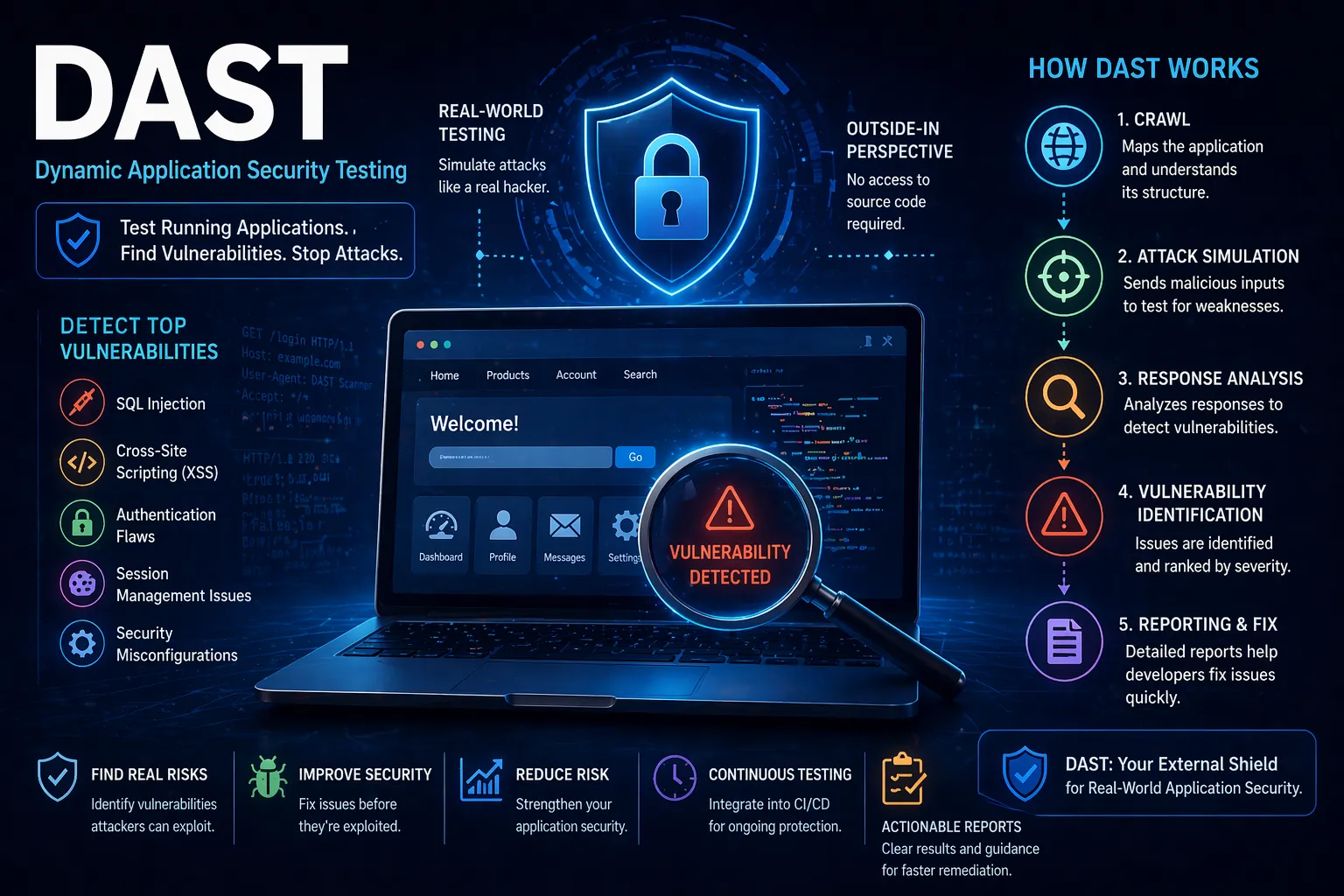
Introduction
Modern applications are constantly exposed to cyber threats — from injection attacks to authentication flaws. While secure coding practices help reduce risk, vulnerabilities can still appear when applications are running.
This is where Dynamic Application Security Testing (DAST) comes in.
So, what is DAST, and how does it help secure applications in real-world environments?
This guide breaks it down in simple terms, explains how it works, and shows why it’s essential for application security.
What is DAST?
DAST (Dynamic Application Security Testing) is a method of testing a running application to identify security vulnerabilities from the outside — just like an attacker would.
Unlike SAST, DAST does not analyse source code. Instead, it interacts with the live application to uncover issues such as:
- SQL injection
- Cross-site scripting (XSS)
- Authentication weaknesses
- Session management flaws
- Misconfigured security controls
DAST is often referred to as “black-box testing” because it tests the application without needing access to the underlying code.
How Does DAST Work?
DAST tools simulate real-world attacks by interacting with a live application and analysing its responses.
Step 1: Application Crawling
The tool scans and maps the application to understand its structure, pages and inputs.
Step 2: Attack Simulation
It sends malicious or unexpected inputs to test how the application responds.
Step 3: Response Analysis
The tool analyses responses to detect vulnerabilities such as improper input handling or data exposure.
Step 4: Vulnerability Identification
Security issues are flagged and categorised by severity.
Step 5: Reporting & Remediation
Detailed reports are generated with guidance on fixing vulnerabilities.
Why is DAST Important?
DAST plays a crucial role in identifying vulnerabilities that only appear when an application is running.
Key benefits include:
- Real-world testing – Simulates how attackers interact with your application
- Finds runtime vulnerabilities – Detects issues missed during development
- No source code required – Ideal for third-party or legacy systems
- Improves overall security posture
Without DAST, organisations risk deploying applications with exploitable vulnerabilities.
DAST vs SAST: What’s the Difference?
DAST and SAST are often used together, but they serve different purposes.
| DAST | SAST |
|---|---|
| Tests running applications | Tests source code |
| Finds runtime vulnerabilities | Finds issues early in development |
| Black-box testing | White-box testing |
| No code access required | Requires code access |
For best results, organisations should use both as part of a comprehensive security strategy.
When Should You Use DAST?
DAST is typically used later in the development lifecycle, including:
- During staging or pre-production
- In production (with safe configurations)
- As part of continuous security testing
This ensures vulnerabilities are identified before attackers can exploit them.
Common Challenges with DAST
While powerful, DAST has some limitations:
- Cannot identify code-level issues
- May miss vulnerabilities in untested paths
- Requires a running application
- Potential false positives
These challenges are best addressed by combining DAST with other security testing methods.
How DAST Fits into Application Security
DAST is a key component of a broader application security strategy, helping organisations identify vulnerabilities in live environments.
A complete approach includes:
- Static testing (SAST)
- Dynamic testing (DAST)
- Penetration testing
- Secure development practices
- Continuous monitoring
To fully protect your applications, DAST should be integrated alongside a comprehensive
Application Security strategy.
Conclusion
So, what is DAST?
It’s a powerful method of testing running applications to uncover vulnerabilities that attackers could exploit.
By incorporating DAST into your security processes, you can:
- Identify real-world vulnerabilities
- Strengthen application resilience
- Reduce risk before deployment
For modern applications, DAST is an essential layer of defence.
FAQs
What is DAST in simple terms?
DAST is a method of testing a running application to find security vulnerabilities.
What types of vulnerabilities does DAST find?
It detects issues like SQL injection, XSS, authentication flaws and misconfigurations.
Does DAST require source code?
No — DAST works without access to source code.
Is DAST enough on its own?
No — it should be combined with SAST and other security methods.
Leave a Reply