
Introduction
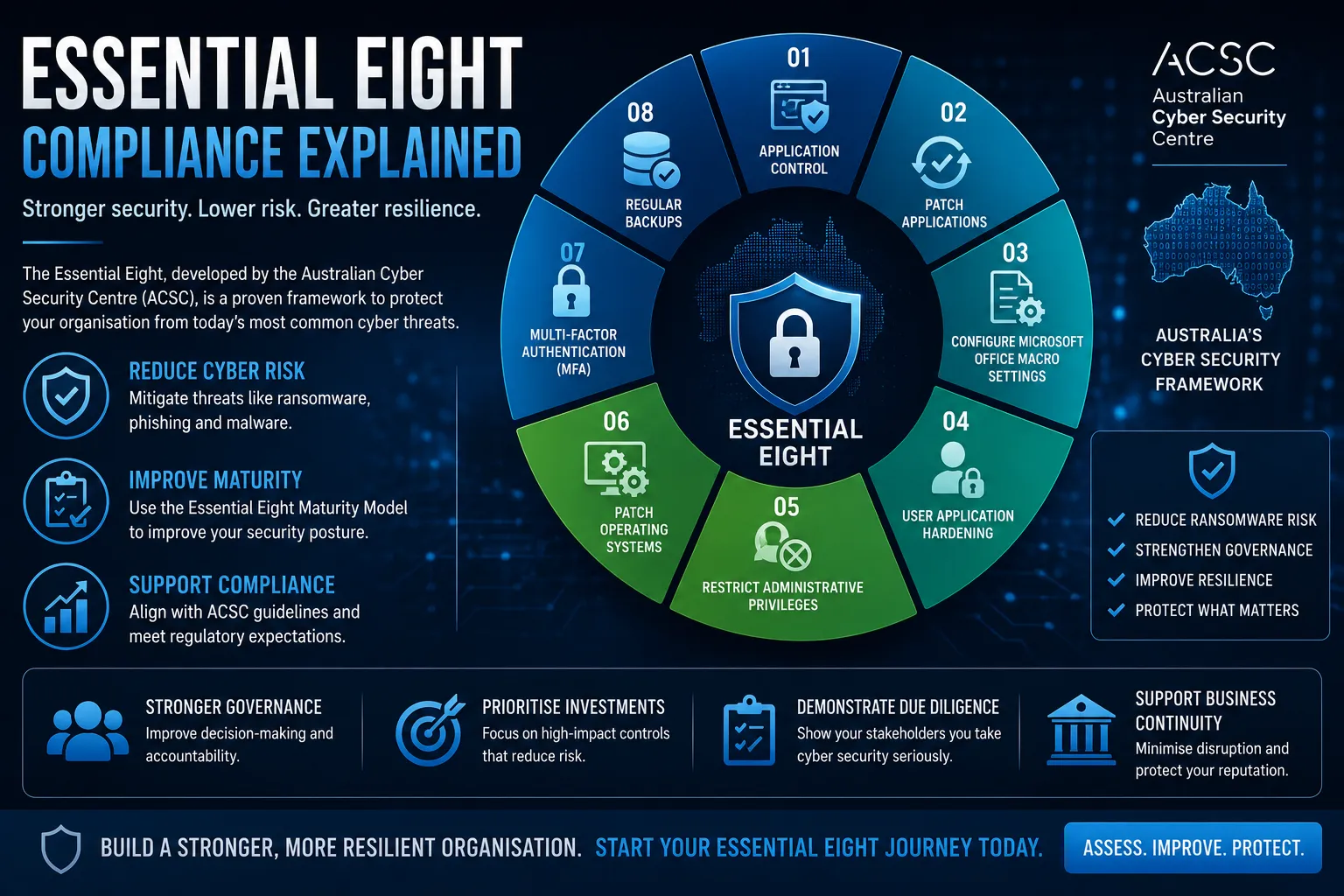
As cyber threats continue to evolve, Australian organisations are under increasing pressure to strengthen their cyber security posture. One of the most widely recognised frameworks for improving resilience against cyber attacks is the Essential Eight, developed by the Australian Cyber Security Centre (ACSC).
Originally designed to protect government agencies, the Essential Eight is now considered best practice for businesses of all sizes looking to reduce the risk of ransomware, phishing, malware and other common cyber threats.
This guide explains what the Essential Eight is, how Essential Eight compliance works and why an Essential Eight assessment can significantly improve your organisation’s cyber security maturity.
What Is the Essential Eight?
The Essential Eight is a set of eight cyber security mitigation strategies published by the Australian Cyber Security Centre (ACSC). These strategies are designed to make it significantly harder for attackers to compromise business systems.
The framework focuses on practical security controls that prevent, detect and limit the impact of cyber attacks.
The Essential Eight consists of:
- Application Control
- Patch Applications
- Configure Microsoft Office Macro Settings
- User Application Hardening
- Restrict Administrative Privileges
- Patch Operating Systems
- Multi-Factor Authentication (MFA)
- Regular Backups
What Is Essential Eight Compliance?
Essential Eight compliance refers to implementing the ACSC’s recommended mitigation strategies and demonstrating an appropriate level of cyber security maturity.
Rather than simply ticking compliance boxes, the goal is to reduce the likelihood and impact of cyber attacks.
Many Australian organisations voluntarily adopt the Essential Eight, while government agencies and critical infrastructure providers may have contractual or regulatory requirements to align with the framework.
The Essential Eight Maturity Model
The ACSC uses a maturity model to measure how effectively organisations have implemented each mitigation strategy.
| Maturity Level | Description |
|---|---|
| Level Zero | Controls have not been effectively implemented. |
| Level One | Provides protection against common cyber threats. |
| Level Two | Protects against more sophisticated attackers. |
| Level Three | Provides the highest level of resilience against advanced cyber threats. |
Most organisations aim to progressively improve their maturity over time based on their risk profile.
Why Is the Essential Eight Important?
Cyber attacks continue to increase in frequency and sophistication. Implementing the Essential Eight helps organisations reduce exposure to many of the most common attack techniques.
Key benefits include:
- Reduce ransomware risk
- Improve protection against phishing attacks
- Strengthen endpoint security
- Improve cyber security governance
- Reduce business disruption
- Support regulatory compliance
What Is an Essential Eight Assessment?
An Essential Eight assessment evaluates how well an organisation has implemented each mitigation strategy.
During an assessment, cyber security consultants typically review:
- Endpoint configurations
- Application patch management
- User privilege management
- Multi-factor authentication implementation
- Backup and recovery processes
- Security policies and procedures
- Overall maturity against the ACSC framework
The outcome is a roadmap outlining practical recommendations to improve compliance and cyber resilience.
Essential Eight Implementation for Australian Businesses
Effective Essential Eight implementation involves more than putting individual security controls in place. Organisations need to assess their existing environment, identify gaps against the Essential Eight requirements and develop a practical roadmap for reaching their desired maturity level. This may involve improving patch management, strengthening administrative privileges, implementing multi-factor authentication, hardening applications and establishing reliable backup and recovery processes. A structured implementation plan helps organisations prioritise improvements according to their existing risks, resources and business requirements.
Understanding the Essential Eight Controls
The Essential Eight controls work together to create multiple layers of protection against common cyber attacks. For example, application control can prevent unauthorised software from running, while patching helps remove known vulnerabilities that attackers could exploit. Restricting administrative privileges limits what compromised accounts can do, while MFA makes stolen credentials more difficult to use. Treating the controls as a connected security strategy, rather than eight separate checklist items, can significantly improve an organisation’s overall cyber resilience.
Essential Eight Compliance Services
Professional Essential Eight compliance services can help organisations understand where they currently sit against the framework and what needs to change to improve their security maturity. An experienced cybersecurity provider can assess existing controls, identify implementation gaps, document findings and develop prioritised recommendations. This can be particularly useful for organisations that need to demonstrate alignment with the Essential Eight to customers, government departments, partners or other stakeholders.
Maintaining Essential Eight Compliance
Achieving an appropriate level of Essential Eight maturity is not the end of the process. Changes to infrastructure, applications, user accounts and business operations can gradually introduce new security gaps. Regular reviews and ongoing Essential Eight compliance activities help ensure that controls remain effective as the organisation evolves. By combining periodic assessments with continuous security improvement, businesses can maintain their Essential Eight implementation and strengthen their ability to prevent, detect and recover from cyber attacks.
Common Challenges with Essential Eight Compliance
Many organisations understand the importance of the Essential Eight but struggle with implementation.
Common challenges include:
- Legacy systems
- Limited internal resources
- Complex cloud environments
- Inconsistent patch management
- Insufficient visibility across IT assets
- Managing privileged accounts
Professional guidance can help organisations overcome these challenges more efficiently.
Essential Eight and Ransomware Mitigation
Many of the Essential Eight controls directly reduce the effectiveness of ransomware attacks.
For example:
- Application control prevents unauthorised software from executing.
- Application patching removes known vulnerabilities.
- Multi-factor authentication reduces the risk of compromised credentials.
- Regular backups enable faster recovery following ransomware incidents.
Together, these controls significantly strengthen organisational resilience.
How This Fits into Your Cyber Security Strategy
The Essential Eight should form part of a broader cyber security and governance program.
Many organisations combine Essential Eight implementation with:
- Governance, Risk & Compliance services to improve security governance and meet regulatory obligations.
- Cyber Security Consultation to develop practical implementation roadmaps.
- Government Cyber Security services to support agencies and organisations working within government security requirements.
Together, these services help organisations improve cyber resilience while demonstrating a structured approach to risk management.
Conclusion
The Essential Eight is one of Australia’s most practical and effective cyber security frameworks. Whether you’re a government agency, medium-sized business or growing enterprise, implementing the ACSC’s mitigation strategies can significantly reduce cyber risk.
An Essential Eight assessment provides valuable insight into your current security maturity while helping prioritise the improvements that will deliver the greatest reduction in cyber risk.
FAQs
What is the Essential Eight?
The Essential Eight is a cyber security framework developed by the Australian Cyber Security Centre (ACSC) that outlines eight mitigation strategies to reduce the risk of cyber attacks.
Who should implement the Essential Eight?
Although originally developed for Australian government agencies, the Essential Eight is recommended for businesses and organisations of all sizes.
What is an Essential Eight assessment?
An Essential Eight assessment evaluates an organisation’s implementation of the ACSC’s eight mitigation strategies and measures its maturity against the Essential Eight Maturity Model.
Does the Essential Eight help prevent ransomware?
Yes. Several of the mitigation strategies—including application control, patch management, multi-factor authentication and regular backups—are specifically designed to reduce the likelihood and impact of ransomware attacks.