
Introduction
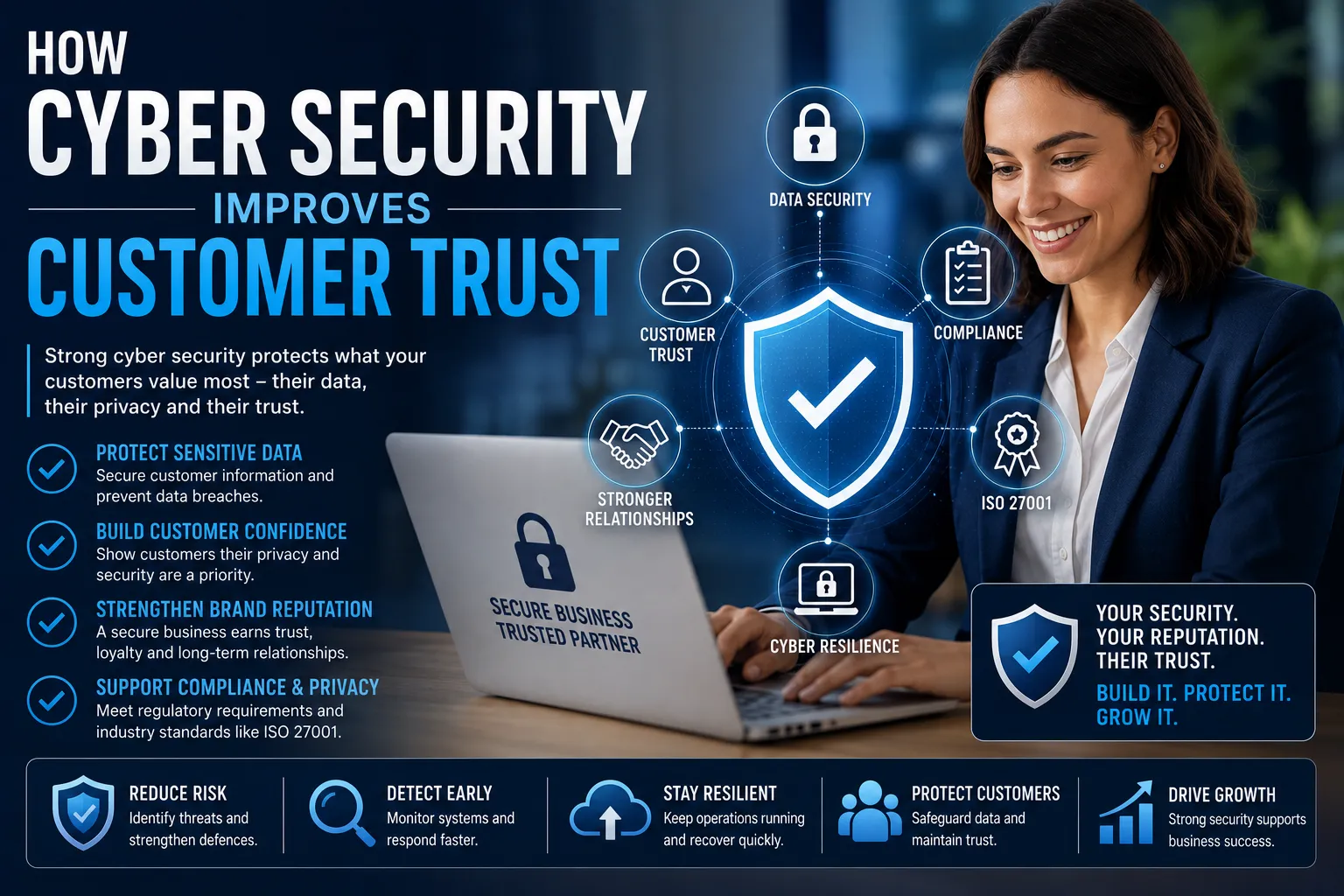
Customers increasingly expect businesses to protect their personal information, financial details and other sensitive data. A business that can demonstrate strong cyber security is therefore better positioned to build confidence and maintain long-term customer relationships.
Cyber security and customer trust are closely connected. Customers may be reluctant to provide information to a business if they are concerned that their data could be stolen, exposed or misused.
This guide explains how effective cyber security can improve customer trust, strengthen brand reputation and demonstrate that your organisation takes privacy and data protection seriously.
Why Cyber Security Affects Customer Trust
Customers place a certain level of trust in every organisation they interact with. When they provide an email address, payment details, identification documents or other personal information, they expect that information to be protected.
A serious data breach can quickly undermine that confidence.
Strong cyber security helps businesses demonstrate that they are actively managing the risks associated with the information they hold.
How Cyber Security Builds Customer Confidence
1. Protecting Customer Data
One of the most direct ways cyber security improves customer trust is by protecting sensitive information from unauthorised access.
Businesses can use measures such as:
- Multi-factor authentication
- Encryption
- Access controls
- Secure backups
- Network monitoring
- Vulnerability management
These controls help reduce the likelihood of customer information being compromised.
2. Demonstrating Strong Privacy Practices
Privacy is an increasingly important consideration for customers when choosing who they do business with.
Businesses that implement appropriate security controls can demonstrate that protecting personal information is an important part of their operations.
Clear privacy policies, sensible data handling procedures and appropriate access controls can all contribute to greater customer confidence.
3. Supporting Compliance
Cyber security is also closely connected to regulatory and compliance requirements.
Depending on the organisation and industry, businesses may need to demonstrate appropriate security and governance practices.
Frameworks and standards such as ISO 27001 can provide a structured approach to managing information security risks.
Demonstrating alignment with recognised security practices can give customers and business partners greater confidence in an organisation’s approach to protecting information.
4. Reducing the Risk of Data Breaches
A data breach can have a significant impact on brand reputation. Customers may question whether they can continue trusting an organisation after their information has been compromised.
Proactive cyber security helps businesses identify weaknesses before attackers can exploit them.
Regular assessments, vulnerability management and security testing can therefore play an important role in protecting customer relationships.
The Reputation Impact of Cyber Security
Brand reputation can take years to establish but can be damaged quickly following a major cyber incident.
A breach may lead to:
- Negative publicity
- Customer complaints
- Loss of existing customers
- Difficulty attracting new customers
- Reduced confidence from business partners
Strong cyber security cannot eliminate every risk, but it demonstrates that an organisation is taking reasonable steps to protect its customers and business operations.
Cyber Resilience Builds Long-Term Trust
Customer trust isn’t only about preventing attacks. It is also about how effectively a business responds when something goes wrong.
A cyber-resilient organisation should have processes for detecting, containing and recovering from security incidents.
This includes:
- Incident response planning
- Regular data backups
- Security monitoring
- Business continuity planning
- Clear communication procedures
Being prepared to respond quickly can help minimise disruption and demonstrate accountability when an incident occurs.
Security Certifications and Customer Confidence
Some businesses use recognised security standards and certifications to demonstrate their commitment to information security.
ISO 27001
ISO 27001 provides a framework for establishing, implementing and continually improving an Information Security Management System (ISMS).
For businesses handling sensitive customer information, demonstrating alignment with recognised information security practices can help provide additional assurance to customers, partners and other stakeholders.
However, certification should complement practical security controls rather than replace them.
How Businesses Can Strengthen Data Security Trust
Businesses looking to improve customer confidence should consider cyber security as an ongoing process rather than a one-time project.
Practical steps include:
- Identify the sensitive information your organisation stores.
- Assess the risks associated with that information.
- Restrict access to sensitive data.
- Implement multi-factor authentication.
- Regularly test systems for vulnerabilities.
- Monitor networks and systems for suspicious activity.
- Maintain secure backups.
- Develop and regularly test an incident response plan.
How This Fits Into Your Cyber Security Strategy
Building customer trust requires a combination of technical security controls, governance and ongoing risk management.
- Governance, Risk & Compliance to establish effective security policies, risk management and compliance processes.
- Penetration Testing Results to identify and understand exploitable weaknesses.
- Cyber Security Consultation to develop a security strategy aligned with your organisation’s risks and objectives.
Together, these capabilities help businesses protect sensitive information, improve cyber resilience and demonstrate their commitment to customer security.
Conclusion
Cyber security is no longer simply an IT concern. It is an important part of the relationship between a business and its customers.
By protecting customer information, maintaining strong privacy practices, meeting relevant compliance requirements and preparing for potential incidents, organisations can build greater customer confidence and protect their reputation.
Ultimately, investing in cyber security helps businesses demonstrate that customer information is treated as something worth protecting.
FAQs
How does cyber security improve customer trust?
Strong cyber security helps protect customer information, reduce the likelihood of data breaches and demonstrate that a business takes privacy and data protection seriously.
Why is data security important for customer confidence?
Customers need confidence that the personal and financial information they provide will be protected from unauthorised access, theft and misuse.
Does ISO 27001 improve customer trust?
ISO 27001 can provide additional assurance by demonstrating that an organisation has established a structured approach to managing information security risks.
Can a cyber attack damage a company’s reputation?
Yes. A significant cyber incident can result in negative publicity, customer churn and reduced confidence from customers and business partners.